Today, I received an unsolicited email from a company claiming to specialize in “Digital Experience” solutions. And that would be enough to discredit the company right there. But they went further: their approach embody everything that could go wrong in acquiring new contacts 🙄
📌 Firstly, they engaged in spamming practices: under GDPR standards, reaching out to individuals without their explicit opt-in is not permissible. While this unfortunate trend is becoming more common, it certainly doesn’t make it ethically or legally sound. 🚫
📌 To add to the absurdity, this company failed to recognize that we were once their customers! Despite their expertise in “Managed Services for CRM Operations” and “Marketing Automation,” they neglected the basic automation process needed to identify and target existing customers 🤖
📌 The lack of effort was further evident as they didn’t even bother to send a conventional text-based email. Instead, they opted for an image! Seriously? A cardinal sin in email etiquette in prospecting: you don’t place images as it often triggers spam filters. Fortunately, our system recognized them as a “known company” and didn’t filter them. Fact that they seem to have overlooked. 📧
📌 Text in German, image in English??? Consistency is the first rule in user experience. I know it’s not always possible with the huge amount of educational materials that a company is expected to provide. But for a single first touch-point Email the minimum you can do is to write in one language. Better would have been to check what is the language I use in LinkedIn (that they cite in the text, taking my job tilte as “automatic dynamic field”) and using dynamic content functions match it with the right text. Basic best practice, I shouldn’t even have to mention this 😔 .
📌 Their offered services were so extensive and varied that it raised skepticism about their credibility. Claiming proficiency in
– website design – brand strategy – CRM management – marketing cloud – SEO – social listening – influencer marketing
all under one roof seemed too good to be true. Any seasoned professional in the digital realm knows the impossibility of excelling in such a wide array of domains. Additionally, if they were truly exceptional in any one area, why not target their communication to me accordingly? 🤔
In essence, this company’s attempt at digital outreach was a textbook example of how not to approach potential clients and left me questioning both their competence and sincerity in delivering quality services. 👎
A piece of advice to agencies / digital partner: invest money and efforts to better target your potential customers and show with your work how good you are. Don’t spam, don’t be generic like this, this is a waste of money for you and frustrate your audience.
Content for digital is normally easier and quicker. Very soon marketing departments are able to produce hundreds of social media posts, new blog pieces, mailings and several landing pages with a speed that is not even closed to the one you might had using only printed materials. This is why keeping graphics and images under control in the digital world, especially within an international environment is extremely difficult.
This is why developing a consistent and strong brand identity is crucial in the dynamic digital landscape. It all begins with a solid idea for your marketing or communication activities, whether it’s a visual, a slogan, or content for various digital channels. However, the excitement of creativity should be tempered with the need for a cohesive Corporate Identity (CI) from the outset.
We all know how it is in the Marketing departments. Im House we can not accomplish everything, or it is rarely that I have seen a marketing dep. being able to really manage all aspect of marketing and communication without any external support. Normally marketing rely highly on marketing agencies / freelance to help in the creation and production of content. This is why there are so many of them.
We know how it is, marketing agencies like to be creative. Actually the more they are creative, the more they can charge you. This is why, if you don’t provide a guideline, they will exploit their creativity and come up with the greatest most creative design for each artwork that you request, which will be probably every time very different, depending on the internationalization of the company also country-specific and most important highly expensive.
Every time agencies will charge you for what it’s called the “conceptual” work, which is basically to think about how to set-up the different design formats and what kind of graphic elements are best. And that is much longer and timely intenst than just work on a “finished format” where they should only include a new logo or text or do small adjustments to fit into the template. Agencies can literally thrive on creativity and without guidelines, they can get carried away, resulting in stunning yet costly creations.
This is why providing a clear format to agencies for content inclusion, instead of paying for conceptual work, proves not only to be cost-effective but also much more efficient.
Advantages of a Corporate Identity
The advantages of a well-defined CI are numerous and I summarize a couple here (you can find more more if you are interested, again I want to express only what it’s outcome from my own experience).
It streamlines communication and collaboration by providing a reference point for everyone involved, improving efficiency and reducing errors. Especially among large marketing team that works across countries or continent, dispersion is very easy. No one wants and can control what happen in the other part of the world meanwhile the company value proposition, through its main message and image, should be communicated and visually expressed consistently and harmoniously among all channels and platforms.
I mentioned how consistency across all digital touchpoints is fundamental, even for smaller companies, ensuring that customers can easily identify and trust your brand. Consistent branding not only builds trust but also fosters customer loyalty. The recognizable color, style, and overall image create a reassuring effect for customers. This trust translates into repeat business, which can be measured through customer satisfaction surveys and retention metrics. It makes the difference when you walk in a busy trade-show full of colors, logos, messages and all kinds of inputs to stand out and be recognized from your customers.
Ignoring the importance of brand guidelines increases the risk of diluting or misusing your brand. Properly implemented guidelines act as a shield, preventing unauthorized alterations and inconsistent representations. Monitoring brand mentions, sentiment analysis, and perception surveys help gauge the effectiveness of brand protection efforts. Especially in the digital endeavors it is so easy to missuses company logos and branding elements. The more the brand is strong and recognized, the more difficult it is to “steal” it for wrong use.
If you live in Italy you know what I am referring to for sure. But as Italy is a very small country and besides I don’t live there anymore and most of my audience is not even able to speak Italian, I want to share with the rest of the world this interesting case of “Image damage” of an influencer (the biggest one in Italy in this case) and what I would do if I was her.
Let’s start saying that Chiara Ferragni popularity is with no doubts a result of excellent use of the social media platforms. She is born in 1987 and moved her first steps into the fashon world as a model when she was only 16. Her journey to fame began in 2009 when she launched her fashion blog, “The Blonde Salad.” Initially, the blog documented her personal style, travels, and daily life, quickly gaining popularity for its relatable content and Chiara’s distinctive fashion sense. She was only very creative in posting all kind of outfits and being always authentic and spontanes.
As the fashion blogging landscape evolved, Chiara Ferragni’s platform transformed into a lifestyle empire. She became known for her collaborations with renowned fashion brands, showcasing her impeccable style and influencing fashion trends globally. Chiara’s innate ability to connect with her audience and her genuine approach to sharing her life contributed significantly to her rapid rise to popularity. She was always very smart in catching the trends and making them as she would participate into their success.
Her Follower base counts almost 30 Million Followers.
Her Target Audience has always been younger predominantly female fashion-lovers but with the time that range of followers expanded into an older audience, not gender specific and more generalist.
In 2022, during the Christmas season, Chiara Ferragni served as the spokesperson for Balocco, a renowned brand specializing in “Panettone,” a traditional Italian winter sweet. The promotional campaign centered around a charitable initiative linked to a special edition of this sweet, bearing Chiara Ferragni’s branding. The campaign pledged to allocate a portion of the sales proceeds to fund research for a specific type of cancer affecting children.
However, a year later, the Italian regulatory authority responsible for ensuring transparent communication and fair competition discovered discrepancies in the execution of the promised charity. Contrary to the communicated information, it was revealed that the anticipated donations had not proceed as outlined. Specifically, Balocco had made a singular donation of €30,000 to a hospital for disease research prior to the commencement of the campaign. Subsequently, neither the influencer, Chiara Ferragni, nor the company Balocco had followed through with any additional contributions following the sales of the branded sweets. Note that one of this Panettone costed more than twice the normal price with the argument, clearly written in the product packaging, that the sale would have help the hospital in this research.
Geographic
When she was a model she was pretty famous internationally as well. Her outfits were often taken in various magazine and other fashion endeavor as well as other international star. In her Blog she focused purely on fashion, trends on Italian Followers more than international after she got married with the singer Fedez, who clearly didn’t have any visibility outside his home country.
Her website https://www.theblondesalad.com/en/ lost 26% of traffic Share* in 2023 in United States where she detain the majority of the traffic. This is why I am saying:
Forget about Italy: move away and build your audience outside
Ok you screwed up.
Leaving the ethical aspect aside, which is in my opinion unforgivable, your target audience in your home country is lost or at least your sponsors are lost. There is no way to gain it back, because even if the fan base stay (and we should ask how many of them just stay in your channel as haters just to see you going down), the companies don’t want to sponsor any Influencers who might be attached to a negative image.
But outside Italy, no one really knows about all this right? This is one of the few advantages when you live in a country whose language is unknown outside of it. So why not start to build your audience back in other countries, focusing for example in the US? For sure the competition is higher over there and you are going to be “one of many” instead of being “the best” like right now, but hey at least you can growth and build your brand new.
Thematic
In this new trend of being “famous” for who they are and not what they do, she attracted other fans who didn’t really care about fashion, rather were more interested on the life of the couple and their initiatives. This of course made the couple very attractive for these kind of sponsor that might use them as “window” for their products. Basically they were acting as a living Truman Show where every moment of their lives was a good opportunity to showcase a brand / product. Ok, nothing wrong with that… It is only very dangerous.
In this new way of communicating, the influencer needed to find always something new to say, to keep people interested in the channels. And that is much more difficult if you don’t have any external inputs to use, like newest fashion trends, but you have to constantly make those input yourself. And even more difficult if you are basically a “typical” family with children living at the end a “normal” life. Normal meaning pretty standard, like going to the supermarkt, bringing your kids to school/Kindergarten and so on…
So what happen is that you want to find new things to say and at the same time find things that people is interest in. In a recent Podcast, the Communication Expert Matteo Flora correctly stated
“When a company finish things to say, they talk about charity”
And that is what happen with her. At that point, for her Italian “new” audience she had, she finished the things to say and started therefore to share charity and “good” voluntary actions to continue keep the attention and resonance around her.
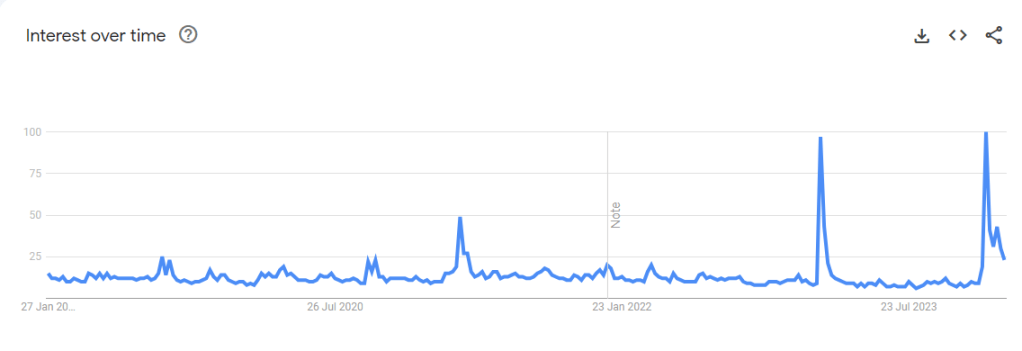
Be aware, the pick of your search in Google happen only when there is a scandal involved…
Google trends Screenshot
Go back to the origins of being a Fashion / Stylist Star
Chiara, your popularity went hand in hand with your fashion skills. You have always been “ahead” of the trends and even inspired new ones, with a very particular characteristic: being the most recognized “feminine” , classy meanwhile stylistic and elegant fashion influencer.
You were the one against ballerina, all in favor of skinny again large, avoiding anything confortable large skirt or pants always favoring stretch and somehow minimalist and very detail oriented. Very Colorful outfit has always been a strong recognition in your brand image, use it. You should own this unique mixed “snobby” posh style and being more than ever everywhere (expect Italy) on social media talking / posting / sharing all about this fashion life.
Play with these topics and keywords in your channels well and improve/increase your content in english and your customers based will developed even stronger and quicker than before. But keep in mind…We are in a global network and the bad press might expand and be picked up by outlets abroad…And then it’s too late.
I already talked about how the marketing activities and in general companies and their internal Departments are changing during this transformational time. Marketing plays a crucial role in this transformation, leveraging digital channels and technologies to reach and engage target audiences.
By embracing digital transformation, marketing professionals can
enhance customer experiences
drive business growth
create new opportunities
This requires a deep understanding of digital trends, adopting agile methodologies, and leveraging data analytics to optimize marketing strategies.
This is why now it is more necessary than ever before to put Marketing (and all that is around it) at the C-level of an organisation. The importance of how your brand and company is perceived in the digital world is as high as the quality of your products. It is not a “nice-thing to have” rather a must of any organisation to build credibility and trust around them in the digital landscape.
In this blog post, we will explore why a holistic approach, encompassing collaboration, data-driven decision making, external partnerships, leveraging internal data, and empowerment, is the key to achieving marketing success.
Marketing&Communication as Strategic Functions
While a direct connection to the C-Level has long been considered essential, it’s time to challenge this traditional belief. . Marketing is not just about executing campaigns or managing budgets. It is a strategic function that requires a deep understanding of customer needs, market trends, and competitive landscapes. Marketing professionals are responsible for crafting strategies that drive business growth and create long-term value for the organization.
Collaboration Across Departments
Marketing success is not achieved in isolation. It requires collaboration and synergy with other departments such as sales, product development, and customer service. By working closely with these teams, marketing professionals can gain valuable insights and align their strategies with the overall goals and objectives of the company.
Data-Driven Decision Making
In today’s digital age, data plays a crucial role in driving marketing success. Marketing professionals need access to accurate and timely data to make informed decisions and optimize their campaigns. This requires collaboration with IT and data analytics teams to ensure the availability and accuracy of data.
External Partnerships
Marketing is not limited to internal efforts alone. Building strong partnerships with external stakeholders such as agencies, influencers, and media outlets can significantly enhance marketing outcomes. These partnerships require active engagement and collaboration, not just a connection to the C-Level.
Leveraging Internal Data
The targeted utilization and linking of cross-departmental internal company data of all kinds will lead to significant competitive advantages. By leveraging advanced data analytics tools and technologies, companies can gain valuable insights from internal data, enabling informed decision-making and a competitive edge.
Success Through Empowerment
Rather than relying solely on a direct connection to the C-Level, marketing professionals should focus on empowering their teams and fostering a culture of innovation and creativity. By providing the necessary resources, training, and support, marketing leaders can drive success from within the department.
Conclusion
While a direct connection to the C-Level is important, it is not the sole determinant of marketing success. Marketing professionals must adopt a holistic approach that encompasses collaboration, data-driven decision making, external partnerships, leveraging internal data, and empowerment. By embracing this approach, we can navigate the challenges of the modern business landscape and achieve outstanding results. Let’s shift our perspective and unlock the true potential of marketing success.
Hi digital peers. Today I talk about Websites and especially I’d like to do a deep dive on the different CMS and my experience with them. On this topic there are tons of materials and information available, but again, often is “biased” by the service that cooperates with the system owners or by the agencies who can only program that platform and are “force” to promote it as better.
To my personal experience, there is not better or worse. All systems have goods and bads and serve different purposes, it really depends what it’s needed and how the website internal the organisation will be used.
I always think that managing a website is like taking care of a garden that keeps growing, balancing the risk of getting dried (too few contents) or over watered (too many pop-ups) and making sure insects or animal don’t penetrate it (cyber attacks) especially if the website has many different parts and languages as well as interactions.
So, whether you’re still working on making your website better or you’ve just finished a big update, it’s a never ending job.
As I said, today I want to focus on the CMS and share my experience with some of them, which I hope it’s valuable for others who might find themselves in the position of having to change it and don’t know which one works better for their needs.
Disclaimer: this list was previously started from our web agency that supported us very professionally in the decision of the system. Still I added my comments and personal insights.
Flexibility:
Administrator Access: All systems provide access to various areas and elements of the website for administrators.
In WordPress it’s easier to grand and change access to different kind of users since you can customize the type of access if you want to give but it’s more difficult to select users by sections (like users who only edit pages translated in one language).
In Enterprise System (like Drupal) the access should be more regulated. You have to know in advanced in which area your areas are going to edit and what they are going to do. If at some point you decide you want users to access one part of the website and only do changes, it might be a problem. In the other hand you always have under control who does what and don’t risk any major disruptions.
Customization: WordPress is terrible for future integration and / or scaling. The number of plug-ins that you might need and the revisions you have to perform to make sure that everything works will drive you crazy. For this reason, if you have clear defined what the website will do and what elements you need, especially if they are pretty simple, like assembling of text/images/videos and updating the blog or news page, wordpress is the way to go. But if you start with one structure, then on the way want to add 5 languages, then you want to integrate an automated platforms and create a download library, include a log-in a area, create a new template custom-made and apply it in all the language translated automatically, add a Chatbot, and so on…Wordpress will drive you crazy.
For enterprise solutions like Drupal or Typo3 or any other scalable CMS systems the customisation capabilities are obviously what their strength is and where they support further developments without crashing. Even if here is also not all great. It really depends on how the “base” is constructed and what building blocks you decided at the very beginning of the set-up. Since every addition is based on a new program parts, often made from different people, it might be impossible to debug a problem or even sometimes old version don’t support new functionalities. So, true this is better with structure CMS, but still if you have to perform major change, it might be a better option to relaunch the website.
Multi-language vs. Multi-Structures This is a crucial point of websites made for companies, especially with a complex sales structure and / or large portfolio. The main question is to decide what is more important for your company: create a base default content that will translated (with small adaptions) to various languages, Independent from the country, entity, business unit or whatever other categorization present in the organisation.
For WordPress for example the management of multiple structure is a nightmare, if you want to differentiate one section and separate it through a different navigation, menu and URL is going to be a challenge. Same thing in Drupal where the default language is going to give you the core structure of the whole website and every page exist based on a template and “page start”.
In other systems, like TYPO 3 or PIMCORE each page is “stand alone” and you can build it independently or create microsite with complete different contents and layout definition. For multi-domain sites with independent page structures these systems are the best one for you. But pay attention, the learning curve is much higher, they are not intuitive nor easy to handle. The users, especially if now web experts, are going to need higher amount of time to master this system. The programming is also in my experience much higher.
This summary provides an overview of the features and considerations for each CMS based on the questions raised.
The first thing that comes into our heads around the notion of digitalisation and in general the digital world is not for “listening” or “convincing techniques”. Normally we think about which programming language we should learn, what tools we should master, what platforms we should use, not to mention the whole ai “buzz” now everywhere (no ai=useless nowadays) . Yet the importance of more “personal” skills tends to be overshadowed.
Not very often I heard about needing other more “personal” skills in relation to the success of a digital journey implementation. But ultimately, people are the primary stakeholders in any digital journey. The success of the implementation revolves around on whether they embrace and adopt the tools and processes developed. Ignoring this crucial aspect can lead to failure, as evidenced by the closure of digital startups, with people cited as the primary reason for their demise.
Just today I read about the fail of a “digital” start-up where the CEO mentioned “people” as the first reason for its failure. He also mentioned that before having a finished product, he should have started with talking with the people first and understand their real needs. And this is exactly what I also learned in my professional experience. It doesn’t bring anything to have a perfect and ultra performing tool or platform if this is not needed or worse hated from their users.
In my professional experience, I’ve learned that certain “personal” skills are paramount when transforming old processes into digital ones or creating new ones. Here are the skills that, in my view, are essential:
Listening, listening and again listening
Absolutely, I am 100% sure about listening in the first place of this list. Before diving into any initiative, it’s crucial to engage with colleagues, understand their workflows, and inquire about their current practices. For instance, again from my own experience, when we had to transition from paper forms to digital devices for collecting contact information at events (like trade-shows), instead of starting with what tool we can use, which device are compatible,… the initial question should have been: “How do we traditionally welcome customers during a physical event?”
Asking this question helps uncover essential details such as whether each salesperson needs an individual device, if a touch-screen for attendees is more suitable, or if having a dedicated person to record information centrally is the better option. Just knowing how the Team usually interact with customers during events lead to understand if a direct collecting in our smartphone even could be a possibility, since they might be too busy talking to them or maybe they might prefer a quick scanning at visit cards and later on include eventual further information.
These insights are only accessed through open discussions and the exchange of information. By actively listening to the team’s input, we can accurately identify the specific requirements that need to be addressed. This collaborative and communicative approach ensures that any digital implementation aligns seamlessly with existing practices and meets the actual needs of the team.
Be Patient and Repetitive
Assuming that a single training session or one email is sufficient for a successful digital implementation process is either living in another universe or indicative of no experience in such projects. Achieving comprehensive learning takes repetition – approximately 10 times to solidify one full understanding. It’s not a reflection of lacking skills or laziness; rather, it’s a reality that individuals juggle various tasks and challenges in their professional lives. They might not immediately apply what they’ve learned due to the demands of their roles.
Expecting users to recall everything from a training or webinar, especially when they try the tool much later, sets the stage for frustration and disrupts the learning experience. It falls on us to be the constant support, reiterating, explaining, and training repeatedly. A positive approach, delivered with a smile and gentle guidance, is key. What may seem obvious to those immersed in the digital realm every day can be challenging for occasional users to remember. Patience and repetition become the pillars of ensuring a smooth and effective learning experience.
Flexibility is your best friend
Sometimes what I had in mind was very far from reality. For example I once created a perfect funnel that started from and adv in social media, followed by a series of email and ending with a 1:1 meeting with an expert.
However, reality struck hard – the social media ads weren’t reaching the right audience, the landing page went largely unnoticed, and the expected clicks simply weren’t materializing. The entire funnel came to an unexpected halt. Internally, the follow-up process faced hurdles due to a lack of information among the experts.
In hindsight, a major misstep was expecting our target audience to react precisely as we envisioned, not accounting for their actual behavior. I fully own up to this oversight; as digital experts, it’s our responsibility to ensure actions align with real habits rather than being overly theoretical. The key lesson here is to stay prepared for quick and frequent adaptations. Flexibility is crucial in the digital realm, where changes in strategy may be necessary to align with the audience’s actual responses rather than our anticipated reactions.
Positive and Enthusiast no matter what
We’re bound to face numerous challenges along the way, with significant pushback and criticism from various stakeholders. This is not surprising, considering human nature tends to resist change and new things. The fear stems from a potential loss of control over tasks and a reevaluation of one’s role in the process. People might feel redundant, especially if their responsibilities shift due to the implementation of new tools. Skepticism is also expected, as past experiences with various digital tools, some successful and others not, might breed doubt.
In navigating these pitfalls, our role as “digital drivers” becomes pivotal. We must show and keep unwavering confidence, positivity and assurance that the changes we’re proposing are not only right but necessary. Reassuring our team that the new ways of working are well-founded and beneficial becomes a crucial aspect of steering through the uncertainties.
Master convincing Technics
The last critical skill for today, which I believe is indispensable, revolves around what I previously referred to as “convincing techniques” or the principles of influence. These serve as highly effective strategies for persuading and gaining the cooperation of others. This becomes particularly crucial when introducing new tools or altering processes that may initially demand more effort, risking resistance if not convincingly presented. Even if such changes are mandated from the top, success hinges on ensuring that the users are not just informed but actively brought on board. Mere decisions won’t suffice; it requires a hands-on approach, ensuring everyone feels heard and valued.
Several influencing techniques prove valuable in this endeavor:
1. Appeal to Emotions:
Engaging individuals passionate about technology, positioning the change as a revolutionary leap forward. It’s vital to be cautious, as excitement may wane if the novelty factor diminishes over time.
2. Logical Reasoning (“Added Value”):
Clearly articulating the benefits the new process or features bring—whether increased efficiency, boosted sales, or other improvements. It’s crucial to consistently highlight the ultimate goals and the positive outcomes.
3. Social Proof and Fear of Missing Out:
Staying informed about industry trends, learning from others, and sharing those insights within the organization. Creating a sense of urgency by looking beyond our immediate context and observing competitors. A robust network is essential for obtaining such information, as it often relies on word of mouth or connections.
In essence, successful implementation goes beyond decisions; it requires creating a narrative that resonates emotionally, demonstrating the tangible value through logic, and staying informed through a strong network. This approach ensures not only acceptance but active participation in the envisioned change.
Disclaimer: Images are generated through ai by the tool Canva
Now more than ever, with the fast development of technology and the increase of complex software/cloud solutions, it is becoming more and more difficult to understand what a product does or what is exactly its new function. If we think about an old Mobile Phone, the old-fashioned NOKIA to understand, the only ability was to make/receive calls.
Afterwards it was made able to send SMS’s, play simple games and memorized telephone numbers. After a while it came the possibility to send/receive emails (I still miss my old Blackberry…for Boomer like me that remains still the very best Smartphones for professional use). But that for many people was already somehow very complicated to manage.
If we look at the Smartphones now there is nothing we can’t do anymore! From E-Mails, Games, Apps of all kind, steps measurements, navigators and much more. But not only that: security passwords with finger scanning or eye/voice recognition, localisation, mobile payments and many other functions. Are all of this making our life simpler? Well in my opinion, it depends. When we understand how these new functionalities work, of course. But is everyone able to learn that quickly? Not really.
How many of us spent hours to understand how to set the iPhone new mode connected to Cloud. And the synchronization? New Updates? Privacy settings in Social Media? New functionalities? Of course there are lot of people who will say that was easy and actually took 5 minutes…Well I am sure there are also many who agrees with me that it didn’t take 5 Minutes and could have been much easier if was better explained.
That is the message of my post today. Makes things complicated, easy, it’s not exactly an „easy“ job. All the way through the digital journey it has always been my prerogative to simply all around the digital experience and functionalities, in order to make it possible for everyone to work with them. Technology is meaningless if not understood and ultimately used. And too many times I experienced cool features and really helpful tools that might have really made an impact in a certain process or within a department, if only it was used. And I can’t blame the users for not doing it. When the strength to learn something new is higher than its benefit, it will simply not been done.
„I don’t understand anything here. It’s just too technical“ – how many times have we heard this? And if they don’t say it, believe me they think it. And it’s not about being lazy here, it’s really about prioritizing. Between all daily activities it is human to choose the ones who bring more benefit with less effort and something difficult to understand and very detailed is not less effort, is a huge effort.
It is very hard to have in the same mindset the ability to concentrate and deep think about complex schemes and in the same time visualizing the idea of the result in a way that other people see the benefit and the advantages, without all the processes behind.
Generally speaking, digital experts, similarly with their IT peers, are „their products”, meaning they know all details and are so deeply immersed in it, that they might not remember the final benefit for the end user anymore, or better they know it but at some point it’s for them become „assumed“. This is why it is for them very difficult to explain again and again what are the benefits for their users and more importantly how to get them.
5 Tipps for a “simple” digital mind-set
Tell and show ONLY what the users NEEDS to see, adapting it according to the target. There is not need to explain the backend of a system or very complex processes through the various tools and channels. Just explain the function and the simple steps to archive it.
Using very simple words. Not everyone knows what is an IP-Adresse or the meaning of RAM or ai. Yes, for the IT people it’s obvious, but in any decision process there will be more than IT involved. Please keep it very child-simple, to the extreme of using word like „memory“ or Database. It might not be 100% accurate but the users understands it.
SEO likes simplicity. Being found in Google is something that every company can’t avoid anymore, and how are the search made? With complex words or very difficult expressions? Even the most expert person in their business will start looking for a simple key-work in their Google search, think about it.
From simple – > complex is always possible, the other way around not. My advice? Start always from the very first and most intuitive benefit and effect of your program/solution and from there start going more and more in details.
Mental associations. The ability here is to compel good product stories, appropriate analogies and memorable metaphors so that the end user immediately knows what the solutions does and wants to know more. The users wants to know and capture at maximum within the least amount of time. In Marketing Material, this translates into a demand for the most useful information in the minimum amount time.
Why relaunch a website? Here the most important reasons:
The infrustructure is old: our website is based on an old Drupal set-up that is more than 5 years old. This is like preistoric ages for websites and it does not sustain new features at all, like the implementation of new layouts or the automatic translation through plug-ins. This alone is a big enough reason to plan the relaunch
The Structure of topics is not reflecting the company structure anymore. In the last years the company went through an internal restructuring with changing some of segmentation and categorization. Especially the market orientation should be now reflecting on the sitemap
We need a clear distinction between Corporate topics and Products. And within Products area we need different moodboards. This is a new requirement and not possible to implement in the existing pages / template.
The Partner (so-called web agency). Yes, let’s talk about the agencies. I know, this is always a taboo topic as most of the time who write about such topics are agencies themselves. Well, I want to touch this because this was one of the reason why I wanted so hardly to relaunch the website: the web agency is not supporting you how a web agency should do and this is creating delay in solving issues and low trust from our internal stakeholders.
Why now? I started as I said several years ago and the website is to these days still there. This is when the reality comes into play. Sometimes in medium/large companies the possibilities to act and make the needed changes are not always happening as we plan, in the timing we’d wish and often is really no one’s fault, it is the way times are. Internal priorities and changes made it possible to start only this year really and from the first action to the launch the window is very long.
What we did this year:
Ensure everyone knows the “Why” : I explained the reasons, earlier. Those were discussed internally with different stakeholders, to make sure we really are all conviced. If the people that will have to work with us and will have to dedicate their time and energy for the website are not more than 100% convinced that this is needed than we have a problem. In my case I was lucky that everyone understood and clearly saw it, but I can image it could be a challenge if not everyone understands the need to relaunch a website
Understand the Requirement: what should a website do?
Multi-language obviously, but how? Should it be by default in english and then translated or should it stand-along whatever language we need
Easy to use and centralized vs. flexible and customize but needs higher level of skills to learn
Should it be able to have a library and act as “PMI” or “DAM” to facilitate and connect different stakeholders who will work on it, or will it be “just” a collection of files displayed in a correct way to promote and create knowledge.
The Goal and Target-Groups
The Goal of a website varies and not all companies and products share the same goal. I will explain this in another(s) posts but surely this is a very critical point but I summarize following points, stolen from my friend ChatGPT but articulated by me:
Online Presence:
“A website serves as a digital storefront that provides information about the company, its products, and services”. Of course, thank you. And I add, it is, in many cases, the first place that people find about a company. If we talk about single product, it might not be the same as product are more and more creating their own “digital images” throughout various channels. But companies, yes I do believe that companies reflect in their corporate website.
Brand Visibility and Recognition:
“Increasing brand awareness and recognition by creating a visually appealing and consistent online representation of the company.” I am not sure about this. I think the website it’s part of the brand visibility but surely not the only one. In this regards, in B2B especially, press and clippings online are still king.
Communication and Information:
“Providing a platform for effective communication with customers, clients, partners, and other stakeholders. This includes sharing important information about the company, updates, news, and contact details.” Again, yes but. Sharing information is definitely done throughout various channels, some of them not even online (I think about shareholders meetings often not even public). Probably for public companies it is true that some information are mandatory to be made available but medium-small size not public companies really don’t share so much in their online presence. As I am a fun of communicating and transparency, I do believe that websites should show more about their real character of a company, not necessarily with “insights” confidential or critical information but with meaningful information about the processes and the true added value of a company or even a department and especially real people sharing their experiences
Lead Generation / Sales facilitator:
“Generating leads and potential customers by encouraging visitors to submit their contact information through forms, newsletters, or other engagement mechanisms.” We enter the space of using the website as a sales tool or part of a sales journey, which is exactly the purpose of this journey that I am about to start. I could write pages about this, but for now I can say that historically websites were not considered in any way as a way to attract customers or generate sales opportunities. Unless the business was completely digital and the website is intrinsically connected to the journey (for example as e-commerce) otherwise in my experience the connection between the online presence of a company and the generation new customers or new businesses is something still not common, at least in B2B. This is due to many reasons, mainly one big aspect revolves around trade-shows still are the key touch-point for this ( I will do a post only about that as I have very strong opinion about the monopolistic approach of the whole trade-shows system). Not to mention that the personal relation seller-buyers are still very valuable, especially because the sale of a B2B product normally requires a series of services attached that should all be managed through a series of people within companies so that the “sales person” become basically a “project manager” less worry about selling but busier in making sure what is sold actually delivers to customers.
In the next posts I will talk about what steps I took in the relaunch of the website especially focusing on:
Update CMS with new standards
Modernize Design & Look
Change structure reflecting new market-orientation
Create a Corporate and Products website
Set-up Templates for Products pages / Landing Pages
To often as a marketing managers I was bombarded from content about how to digitize the marketing activities, how to relaunch the website, the best practices in lead generation and now of course how to best integrate ai in our work.
Well what I never read anywhere is to actually do all these things in companies, in the real workplace within the real Environment. I guess because most of all this content has been written from agencies or consultants, who have the time to produce it and who is also paid to do it, who basically is “forced” to produce such content.
Professional in companies don’t have neither the time or the need to write “guide” or educational content to help other peers in the same situation. They already struggle enough in their own one, let alone communicate what they have been through in any kind of form.
This is why I decided to start a diary in this journey, which I am embracing right now in the company that I am working on.
Following are my propositions:
Document every steps: so that I’ll able to recall the decisions making process, especially important if in the long run not successful
Clarify my thoughts: when you put things in writing, you are forced to think through
Weekly update: I want to post something every week because consistency is necessary to be effective
Stay neutral: it is not about the company or the team, it is about what I want to archive and how
The intention is to use this as tool for myself as well as heritage of this journey.
When I started with this company I brought with me the proposition of digizing the marketing acitivities and being able to measure and track all marketing activities in order to analyze them and make data-drive decisisions.
What I realize this is much more than just “marketing” or “communication”. The transofrmation should start in the processes first. How we collect the leads should come after we define what is a lead and what parameters define it.
And to be able to understand that, there is much more to know and find-out inside an organisation, that goas beyond the department of marketing or sales or any other department.
This is why I want to write down the process, the phases and the stages, because I know there are times where you feel like you are not moving, you are not making any progress and it is all for nothing. Yet in those moments I will look back at these pages and remind myself, yes we are moving and yes things are changing, don’t give up.





 The Diary of a digital Journey