Category: Sustainability

  • Understanding Consumer Perception of Sustainable Ingredients – Part 3

    Understanding Consumer Perception of Sustainable Ingredients – Part 3

    Understanding the psychological factors that drive consumers to choose sustainable food products can help businesses tailor their marketing strategies and product offerings.

    The results from Nielsen Company “2014 Report – Millennial Breaking The Myths” with 30,000 participants in 60 economies suggests that millennials are willing to spend extra for the products and services offered by firms committed to sustainability issues.

    Another study published in 2016 in the Journal of Business & Society titled “Corporate Social Responsibility and Consumer Behavior: A Meta-Analytic Review” conducted a metaanalysis of over 300 studies and found that consumers are more likely to purchase products from companies that are perceived to be socially responsible, which includes efforts towards sustainability, including ingredient sourcing practices.

    Which psychological factors trigger consumer choices?

    Knowing the psychosocial factors that may predict a food choice product may be useful to understand what drives consumers to choose this category of food.

    Buying behavior theories

    Between 50% and 99% of brain processing is occurring without our awareness. There’s a whole lot going on in our brain that we just aren’t aware of and don’t have access to.
    There’re a lot of theories and evolutionary reasons for that. We can’t possibly think about every single decision we make. It would be exhausting, and we’d be paralyzed. Our memories and our conscious awareness of our behaviors are very limited.


    This unawareness should be considered when analyzing the results of our research and
    include psychological, social, and economic factors that might influence consumer behavior towards the decision of buying or not.

    Social Cognitive Theory:

    • Consumers’ perception of control over their purchasing decisions plays a significant role in how they respond to sustainability claims. Empowering consumers through interactive marketing platforms can enhance this sense of control.
    • References: Qian Wang, Junsheng Dou (2016).

    Emotional Appeal:

    • Emotions such as hope and pride can drive sustainable consumption. Positive reinforcement and public recognition of sustainable choices can motivate consumers to act in environmentally responsible ways.
    • References: Katherine White (2019).

    Theory of Planned Behavior:

    • The integrated model of planned behavior and value-belief-norm explains how psychological determinants influence consumers’ intention to purchase natural and sustainable food products.
    • References: Carfora et al. (2021).

      Conclusion By understanding and leveraging the psychological factors that influence sustainable food choices, businesses can more effectively communicate their sustainability efforts and drive consumer behavior.


    1. Understanding Consumer Perception of Sustainable Ingredients – Part 2

      Understanding Consumer Perception of Sustainable Ingredients – Part 2

      Today I want to introduce the concept of Green Marketing.

      What does Green Marketing mean? Green marketing, also known as sustainable marketing or eco-marketing, refers to the practice of promoting products or services based on their environmental benefits.

      Disclaimer: Despite the increasing adoption of green marketing strategies by organizations, there is a gap in the literature when it comes to examining consumer perceptions of the alignment between these strategies and their beliefs. Scholars studying sustainable consumption assume that sustainability is positive

      Green marketing has become a crucial strategy for businesses aiming to appeal to environmentally conscious consumers. This post explores the effectiveness of green marketing and its impact on consumer behavior.

      I found one study from 2011 investigated how two sustainability dimensions (i.e., environmental and economic) and price can influence consumer responses and was found an interaction effect between consumer support for sustainability and corporate sustainability; consumers evaluate a company more favorably if the company shares the consumers’ social causes. “Overall, we conclude, from our empirical study, support for the idea that consumers do respond to multiple dimensions of Sustainability” (Sungchul Choi • Alex Ng 2011).

      In 2009, Grail Research performed a survey of 800 green consumers in the United States
      and found a correlation with pricing of products. Consumers who have never purchased
      green products are stopped from doing so because they are thought to be too pricey,
      according to this study. “The biggest reason why people do not buy green products is
      because they are too expensive”

      Here are some key aspects of green marketing related to the consumer perceptions:

      1. Evolution of Green Marketing:
        • Green marketing strategies have evolved over the past two decades, focusing on educating consumers about environmental issues and promoting sustainable practices.
        • References: Lakshmi Viswanathan, George Varghese (2018).
      2. Consumer Response to Green Marketing:
        • Studies show that consumers respond positively to green marketing when it aligns with their values and provides clear, actionable information. However, overabundance of eco-labels can sometimes confuse consumers.
        • References: Pancer et al. (2017), UNOPS (2009).
      3. Case Studies and Success Stories:
        • Successful green marketing campaigns often involve transparent communication and verifiable claims, helping consumers make informed choices and fostering brand loyalty.
        • References: European Commission (2022), Nielsen (2023).

      Conclusion Effective green marketing requires a balance between educating consumers and providing clear, trustworthy information that aligns with their values and environmental concerns.

    2. Understanding Consumer Perception of Sustainable Ingredients – Part 1

      Understanding Consumer Perception of Sustainable Ingredients – Part 1

      Consumers are increasingly concerned about the sustainability of the products they purchase, especially in the food industry. This growing awareness has significant implications for businesses looking to align with consumer values and meet market demands.

      In these blog posts serie I delved into the consumer perceptions of ingredients products in the food industry and how do efforts towards sustainability are perceived by end consumers and how does this impact their purchasing decisions.

      Some of findings were quite new to me while other are more a confirmation of what’s known. This is why I decided to dedicate a series of blog post to this as might be useful for professional in the food Industry market.

      Consumers expectations

      In today’s evolving marketing landscape, it has become crucial for food producers to differentiate themselves in the marketplace by offering unique products. In the past, simply producing a high-quality product was enough.

      However, consumers now demand products that not only meet their needs but also align with their social or environmental values. As a result, companies need to consider the social and environmental appeal of their products in order to stay competitive and meet the changing preferences of consumers

      Eco-labels

      Currently, there are more than 450 different eco-labels available, and more being developed as we speak. Meanwhile consumers are becoming more environmentally conscious and socially responsible, and they are increasingly seeking products that align with their values, including sustainability.


      Meanwhile consumers in industrialized countries are nowadays much more interested in information about the production methods and components of the food products that they eat, than they had been 50 years ago.

      What are consumers they looking for?

      1. Consumer Awareness and Preferences:
        • The research highlights that consumers are more aware of the environmental impact of their food choices than ever before. They seek transparency and accurate information on ingredient labels to make informed decisions.
        • References: Ajay Menon & Anil Menon (1997), Lakshmi Viswanathan, George Varghese (2018).
      2. Impact on Purchasing Decisions:
        • Consumers’ purchasing decisions are influenced by the presence of sustainability claims on food products. Clear and trustworthy labels can enhance consumer trust and drive purchasing behavior.
        • References: Sherry Frey of NielsenIQ and Jordan Bar Am, Vinit Doshi, Anandi Malik, and Steve Noble (2023).
      3. Challenges and Opportunities:
        • Despite positive attitudes towards sustainable products, there is often a gap between intention and actual purchasing behavior. This discrepancy presents both a challenge and an opportunity for marketers to bridge through effective communication.
        • References: Katherine White (2019), Sergio Silva Braga Junior et al. (2014).

      Businesses that prioritize and communicate their sustainability efforts are more likely to attract environmentally and socially conscious consumers, leading to increased sales and brand loyalty.

    3. Green Hushing and avoiding communication about environmental initiatives and sustainability

      Green Hushing and avoiding communication about environmental initiatives and sustainability


      The Reputation Institute says 91% of consumers want to engage with brands with strong CSR. This need of transparency reflects a broader trend toward corporate accountability and sustainability, driven by heightened expectations from stakeholders, investors and consumers to regulators and civil society.

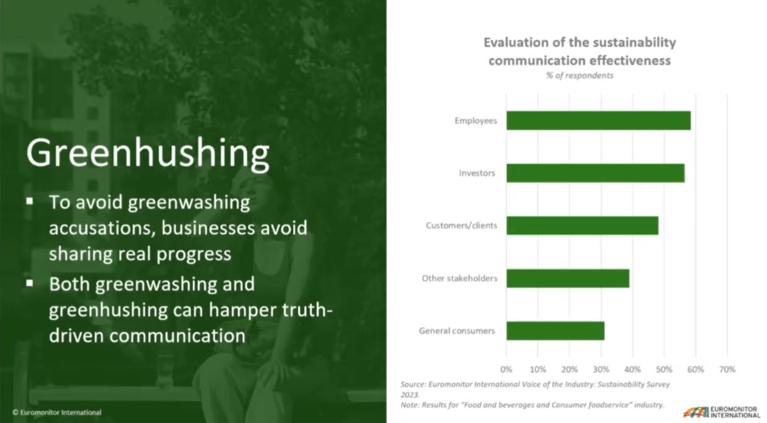
      Transparency, as manifested through comprehensive ESG disclosure, is seen as a mechanism for fostering trust, enhancing stakeholder engagement, and promoting responsible business practices. Yet, many companies are taking a step back and started practicing what is called “Green Hushing”.

      The term green hushing was coined in late 2022 by Zurich-based consultancy South Pole, after a study the same year surveyed 1,200 private companies in 12 countries and 15 sectors on their net-zero progress. It found that 72 percent of the companies surveyed had set emissions targets in line with global climate goals. However, the study also found that one in four companies do not plan to talk publicly about their climate-related goals.

      This can be explained for several reasons:

      1. Fear of Scrutiny: Companies may be concerned that their environmental claims could be scrutinized or criticized, especially if they are not fully meeting sustainability goals or if there are discrepancies in their practices.
      2. Avoiding Greenwashing Accusations: To steer clear of being accused of Green washing (making misleading claims about the environmental benefits of a product, service, or company), some organizations choose not to publicly share their sustainability efforts.
      3. Competitive Advantage: Some companies might view their sustainability strategies as a competitive advantage and choose to keep them confidential to prevent competitors from copying their practices.
      4. Uncertainty in Regulations: With evolving regulations and standards around environmental claims and sustainability reporting, companies might hesitate to communicate their efforts until there is more clarity.
      5. Incomplete Initiatives: Companies might prefer to remain silent about their environmental efforts until they have fully developed and implemented their initiatives to avoid premature disclosure and potential backlash if the efforts fall short.

      By engaging in green hushing, companies aim to mitigate risks associated with public and regulatory scrutiny while still working towards their sustainability goals internally.

      This is in my opinion very short-sighted from company’s perspective. In today’s dynamic business landscape, where consumers are more and more informed and therefore interested on how companies behave (especially in topics related to social responsibility), companies are expected to share more information.

      This is not something companies can escape nor avoid.

      Firstly for most large companies based in the EU or generating over EUR 150 million in EU the Corporate Sustainability Reporting Directive (CSRD) will be a mandatory open report from 2025.

      Furthermore According to a study from 2022, among consumers, increasing visibility and the disclosure of information has always positive effects in the strengthening of trust among consumers. No matter is at that certain point collected data are not as positive as you might wish for, alone the facts that they have been showing and made available is a sign of responsibility and accountability.

      Being trust is nowadays becoming more important than money.

      But how does it have to do with digitalization? Only through digital tools and platform the process of gathering data and communicating will be enabled. Some examples:

      Automation of Data Gathering: Digital tools can automate the collection of sustainability data, reducing human error and increasing efficiency. For instance, IoT devices can monitor energy usage, emissions, and resource consumption in real-time.

      Centralized Data Repositories: Digital platforms can centralize sustainability data, making it easier to manage, analyze, and report.

      Real-Time Reporting: Digitalization allows for real-time data collection and reporting, which can improve the accuracy and timeliness of sustainability reports.

      Standardization: Digital tools can help standardize data formats and reporting structures, aligning with CSRD requirements and making comparisons across companies more straightforward

      Interactive Platforms: Digital platforms can facilitate better communication with stakeholders by providing interactive and easily accessible sustainability reports.

      About 66% of consumers want to know about the brands they engage with, and nearly 60% want to hear about it on social media. Rather, respondents believe brands are more effective on social media when they announce donations to specific causes (39%) and encourage followers to take specific steps to support causes (37%), such as participating in events or making their own donations.

      Feedback Mechanisms: Digital tools can include mechanisms for stakeholder feedback, enhancing engagement and accountability.


      So my takeaways: Digitalization is not a “nice-to-have” project in organisations, rather the very starting point to be able to comply with CSRD as well as having sustainability data more accurate, accessible, and actionable. Ultimately by leveraging digital tools and technologies, companies can achieve greater transparency, efficiency, and stakeholder engagement hence create and enhance trust.