Category: Website

  • Redefining Tech with Ethics: “Whoever writes the code dictates the rules.”

    Redefining Tech with Ethics: “Whoever writes the code dictates the rules.”

    At the inaugural FPS2025 summit, one of the most captivating conversations centered on the intersection of artificial intelligence (AI), privacy, and the ethical implications of technology.

    Meredith Whittaker, President of Signal and a vocal advocate for tech accountability, engaged in a thought-provoking discussion with Matteo Flora, the most expert on AI and digital reputation in Italy and probably one of the most prominent at global level. Their conversation, which took place in L’Aquila, Italy, highlighted critical issues in the tech industry today — from the dangers of surveillance capitalism to the ethical dilemmas of AI deployment

    I decided to dedicate this post to this interview, that I found incredibly important and yet not seen / heard enough.

    The Code Dictates the Rules: Who’s Behind AI?

    A central theme of the conversation was the idea that “whoever writes the code dictates the rules.” Whittaker emphasized the profound implications this has for our society.

    With the rise of AI, we are seeing unprecedented scales of power being concentrated in the hands of a few tech giants who not only control vast amounts of data but also influence societal norms and political landscapes.

    AI, she explained, is not magic but simply sophisticated code executed on powerful hardware platforms. However, these systems are often built on biased data, reflecting the interests of a small group of corporations with a profit-driven agenda. Whittaker raised concerns about the monopolization of AI development, highlighting how only a handful of companies own the infrastructure and the data that train these systems. This creates a dangerous asymmetry in power, as these companies dictate the narrative surrounding AI, often casting it as a superhuman force that society should revere.

    The Ethics of AI and Data Collection

    One of the most pressing issues discussed was surveillance capitalism—the business model that underpins much of the tech industry. Whittaker contrasted this model with the mission of Signal, which is to provide a secure, private communication platform that respects user privacy. She pointed out that the current tech landscape, where personal data is collected and monetized, is not designed with the user’s best interest in mind.

    Signal, as a nonprofit organization, faces the challenge of maintaining its privacy-first model in an industry that thrives on data exploitation. Running such a platform at scale costs millions of dollars annually, and Whittaker explained that if Signal were a for-profit company, it would inevitably face pressure from investors to compromise its privacy standards for the sake of profit. This is why Signal must remain independent of the profit-driven business models that dominate the tech industry.

    The Global Impact of Privacy

    Throughout the conversation, the global implications of tech and privacy were a recurring theme. Whittaker discussed the importance of cross-border communication and how platforms like Signal empower people worldwide to connect securely. Unlike nationalized versions of tech products, which would be restricted by jurisdictional boundaries, Signal’s universal design ensures that it works seamlessly for people across different countries and cultures.

    In addition to tech’s global reach, Whittaker also emphasized how AI can contribute to the homogenization of culture, creating a risk of losing linguistic diversity and cultural richness. She cautioned against the dangers of AI reflecting only the narrow perspectives of a few dominant cultures, particularly those in Silicon Valley, and warned that this could stifle creativity and unique ways of thinking.

    Basically the message is: “Most – all – digital large global platforms are designed to collect user data, making it nearly impossible to build similarly large, stable, and user-friendly platforms without relying on data-driven ROI. The very basic infrastructure is nearly impossible to build without huge investment”

    Building a Better Future with Tech

    Despite the challenges and ethical quandaries, Whittaker remains optimistic about the potential for change. She advocates for innovating the business models behind tech, suggesting that true innovation lies not just in new technologies but in rethinking how these technologies are funded and distributed. She sees a future where privacy and fairness are not afterthoughts but foundational principles.

    The conversation at FPS2025 ended with a call for a societal shift. Whittaker urged policymakers to adopt regulations that challenge the current business models and protect individual rights in the face of rapidly advancing technology.

    She also urged the European Parliament to embrace a more equitable tech ecosystem, one that does not succumb to the dominant narratives set by large corporations but instead fosters a digital environment that works for everyone.
    Especially now that the UE signed a letter with 44 European CEOs asking the EU to pause the AI Act for two years, it is the time to rethink the legislation and make it suitable for innovating while ensuring parity and equal rights.

    The Bottom Line: Tech for Good

    Whittaker’s reflections underscore the importance of ethical tech in the modern world. As AI continues to reshape our societies, the conversation about who controls the code and how that power is used has never been more crucial.

    Through platforms like Signal, Whittaker and her team are pushing back against the status quo, demonstrating that it is possible to build technology that prioritizes privacy and fairness over profit. The challenge, however, remains: will we as a society allow this vision to flourish, or will we continue to let surveillance capitalism dictate the rules?

    In the end, Whittaker’s message is clear: the future of tech must be inclusive, transparent, and accountable. It’s up to us — the users, the builders, and the policymakers — to decide how we want that future to look.


  • A Guide to Ensuring Compliance with Privacy Laws

    Always more companies operating in different countries and regions will rely to many websites and online visibility spaces. The era where 1 company = 1 corporate website it over in my opinion. Of course we should differentiate. The corporate pages are more than ever needed to provide a consistency image across the organisation, to centralize the traffic from the most important stakeholders and to express a unified and interconnected image of the company and its products.

    This does not mean we should close our eyes on the local growing needs of different windows, especially when it comes to digital. The Stakeholders approached by a corporate website might not be the same as the one you can address with another kid of language and content. And both are valid and correctly representing the company. It is like to say if you have a Instagram channel, you don’t need an X Account. As a company you might need to have them both, as you speak different content across the two channels and to different audience.

    Let’s talk about Stakeholder-based Digital Communication

    I talked about the importance of Corporate Identity for the success of a global digital marketing and how much having Corporate Guidelines is fundamental for the success of global projects. However, we can not underestimate the various differences based on local customs. Some cultures want to watch videos and they should short and fast, better if simple. Other countries where people interact with strong opinions love debates and write huge comments below each posts creating real conversations that go beyond the initial post. More reflecting population might like to read a lot before convincing about one product or solution, for them books are even better than digital channels!

    This is why, thinking that an organisation could survive with only one website is asynchronous, and we should accept the reality of having to manage different web spaces, as marketing / digital leader. That doesn’t mean we should underestimate the workload and resources needed to deal with this.

    While customization is key, maintaining a consistent brand voice and messaging across various digital platforms is equally important. Consistency builds trust and reinforces your organization’s values. Always ensure that the digital communication strategy aligns with your brand identity while adapting to the unique characteristics of each platform.

    No matter if locally or centrally managed, each local website or so-called “microsite” have the same requirements when we talk about security and compliance.

    the ever-evolving digital landscape, safeguarding user privacy has become a paramount concern for businesses worldwide. As the digital ecosystem continues to expand, so do the regulations governing the collection, processing, and storage of user data. In this blog post, we’ll explore key steps to ensure compliance with applicable privacy laws, providing a Roadmap for businesses to navigate this complex terrain responsibly.

    Understanding Applicable Privacy Laws

    The first crucial step in maintaining a privacy-conscious approach is to thoroughly research and understand the privacy framework that applies to your target audience. Different countries have enacted various privacy laws to protect user data, such as the General Data Protection Regulation (GDPR) in Europe, the California Consumer Privacy Act (CCPA) in California, and the Lei Geral de Proteção de Dados (LGPD) in Brazil. Recognizing the specific laws that pertain to your users is essential for building a robust privacy strategy.

    Clear Privacy Policies

    Once you’ve identified the applicable privacy laws, it’s time to craft and maintain a clear and concise privacy policy in accordance with local regulations. This document should transparently outline how user data is collected, processed, and stored. Accessibility is key, so ensure that your privacy policy is easily available on your website. A well-drafted privacy policy not only demonstrates your commitment to user privacy but also serves as a crucial point of reference for your users.

    Consent Mechanism

    Implementing explicit consent mechanisms is a fundamental aspect of privacy compliance. Clearly articulate the purpose of data collection and obtain user consent before processing any personal information. Make these consent mechanisms user-friendly and ensure that users have the option to opt-in or opt-out easily. By prioritizing transparency and user choice, businesses can establish a foundation of trust with their user base.

    Collect Only Necessary Data

    In the age of data-driven decision-making, it’s tempting to collect as much information as possible. However, privacy compliance requires a more discerning approach. Limit data collection to what is strictly necessary for the intended purpose. Avoid the temptation to gather excessive or irrelevant information from users, as this not only helps maintain compliance but also fosters a sense of trust and credibility with your audience.

    In conclusion, as technology continues to reshape our digital experiences, prioritizing user privacy is non-negotiable. By understanding and adhering to applicable privacy laws, crafting clear privacy policies, implementing robust consent mechanisms, and collecting only necessary data, businesses can navigate the intricate web of privacy compliance successfully. In doing so, they not only protect their users but also build a foundation of trust that can drive long-term success in the ever-evolving digital landscape.

  • Witch CMS (Content Management System) to chose (Part 2)

    Welcome back to the second post into the world of Content Management Systems (CMS). In our previous discussion, I talked about some technical features he fundamental aspects that lay the foundation for selecting the perfect CMS and enabling Flexibility, Customization and Multi-language.

    Ai generated image

    Today, we continue our journey, aiming to unravel additional critical criteria that should be at the forefront of your decision-making process and therefore I want to start touching the security aspect. To do that, I need to introduce two main kind of CMS: open-source and close-source.

    The Open Source, means that the code is available for everyone and a community of users can participate in fixing bugs and / or keep it updated. The close type consists on having the programs not visible and “covered” behind companies that will maintain, update and keep improving, without a shared community, in a proprietary way.

    I dwell into both advantages and disadvantages:

    Open-Source

    Popular CMS platforms are often more targeted by attackers because compromising them provides access to a larger number of websites. The source code is available to everyone and if the initial creator of the company goes bankrupt, the code remains available as well as further updates and improvements.

    According to a research published last year for the National College of Irland WordPress is the most widely used content management system (CMS), with 455 million websites supported and a 60.3% market share. 92% of the vulnerabilities found in the WordPress-powered websites are due to the third-party plugins and programming errors.

    WordPress, being the most widely used CMS, is obviously frequently targeted. However, popular CMSs also benefit from large communities that actively work on security improvements.

    To make sure that these continuous improvements actually arrive also to your website, the system uses updates. They can be small or large. WordPress makes updates all the times, especially affecting the functionalities of Plugins. Drupal has updates less frequently but normally larger and more comprehensive. The effectiveness of the update mechanism plays a crucial role in the overall security of a CMS.

    CMS platforms with automatic updates or robust update notifications make it easier for users to stay current with security patches. Downsize: each update requires adjustments in the code and in the backend, which requires programming and thus costs. Some of the large update I experienced to be quite costly (in the 5 digits) and they are mandatory and often difficult to predict how expensive they will be.

    Proprietary

    In the proprietary type it would be much more complicated to access the source software and thus crack it. But the downside for this kind of CMS is surely that the company is fully in charge and you are totally depending to the quality of the programming and the speed of fixing any errors.

    Second it could cost much more, as the company provider of the system can decide to increase the prices once you started with them to just perform updates and you have to accept it.

    The advantages of a proprietary CMS is the complete control of the source code by the creator. If you don’t want the source code tampered with, this is the alternative to choose.

    Another advantage ist that the integration with other platforms and systems is probably more seamless as both working on the latest version and most accurate version of the system. Proprietary CMS platforms often provide integrated solutions that are designed to work seamlessly together. This can lead to a more cohesive and efficient user experience, as the various components are developed and optimized by the same team.

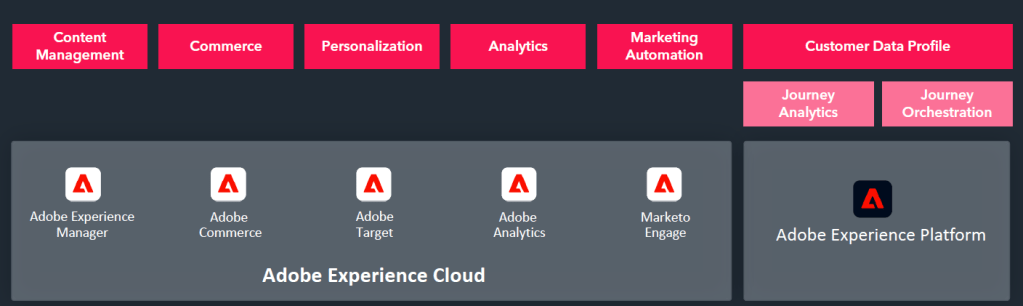
    The best example is Adobe, that offers all kind of other Solutions into the Adobe Experience Platform.

    Screenshot from Adobe Pitch Presentation

    I have never used Adobe in particular, but I did see what is capable of in one company and I was really impressed. They managed a huge integration of different e-commerce and websites, all controlled centrally and accessing the same digital assets. It would be interesting to learn if they also integrated Marketing Engagement and how that worked, especially considering the limitations or absence of GDPR prerogatives in many American Software companies.

    My experience in general is that such huge mega platforms are in theory great and surely on the long run very efficient and robust. But it takes much longer to implement everything until it works, align all the data-set, create the right structure and retrieve all the necessary data that it might discourage and / or limit the Realisation after all. Not to mention the time and commitment to train all the people working with it.

    Conclusion

    if you are not a super digital expert and you don’t want to invest huge amount of time to implement and learn how to manage a complex CMS, go for the Open Source. Also if you are not sure about the partner and you might want to keep the options open and being able to change along the way.

    If you are ready to embrace the challenge and really take the most of an integrated platforms and also you have the company back you up, then go for the close-source. Also for a security point of view, if companies treat very sensible and high risk data / products, that would be also advisable.

  • Navigating the Complexity of Digital Project Management: A Structured Approach

    Embarking on a new project, be it a website relaunch or the creation of a company newsletter, often prompts a desire to involve a diverse array of perspectives. So you organize large group sessions with various name: Kickoff meeting, “Brainstormings”, creative exchanges and all kind of encounters of this kind.

    Many people from different background and expertise, joining without having any preliminary discussion or briefing, having different experiences and knowledge as well as understanding of the purpose of the project. What is happen is that normally the loudest and more talkative person take the stage and becomes somehow the “authority” in the room, some people follow what he/she says and make small adjustment or amends, a few might have different points of view and try very carefully to point them out, being carefully not to be creating too much fuss, and the rest, let’s say the majority don’t actually say anything. Probably because they know they either won’t be heard or think what they would say don’t bring any value.
    At the end of such meetings, the result is obviously very biased and don’t take in consideration “unheard” needs or different perspective. Setting the project off with a shaky start

    After years of navigating this common scenario, it’s evident that these meetings often fall short of delivering positive results for various reasons:

    Absence of Key Decision-Makers

    The presence of decision-makers, especially executives like the CEO, is crucial in shaping the direction of a project. Without their input, discussions may lack the necessary strategic guidance, potentially leading to decisions that require reconsideration or adjustment.

    Exclusion of End Users

    Projects designed to benefit end users suffer when those users are not actively involved in the early stages. The absence of user feedback and engagement in the development process can result in solutions that miss the mark, failing to address the specific needs and preferences of the intended audience.

    Lack of Uniform Problem Understanding

    Assumptions about shared understanding can be perilous. Not everyone may grasp the intricacies of the challenges at hand, leading to misguided decisions or oversights in addressing critical issues. A comprehensive understanding of the problems is vital for crafting effective solutions.

    Diminished Concentration in Group Settings

    In-person meetings, despite their intentions, often lead to diminished concentration spans. This observation, though not formally studied, has practical implications. Participants may grow fatigued, hindering the effectiveness of discussions and potentially compromising the quality of outcomes.


    In my recent experience on working with several different teams across the globe on the same digital projects (let it be website relaunch or company newsletter) I realize that the most difficult thing is outside the typical “IT” world, to apply the same way of working with peoples not used to it, as basically in all other fields and professions, you are not though a method to work together.

    In marketing or finance, or any sociology kind of studying field, there is very high probability that you never heard of the “Agile methodologies, or the Scrum framework”: basically learning how to to truly understand others need and being able to reflect them into the final outcome of the project.

    I am not saying everyone should work like a typical “IT person” (although with increased use of technology in all fields of our life it might not be a bad idea) but I am say at least we should switch our mind-set approach to a more structured way of working together when it comes to digital projects.

    Here are key insights and recommendations:

    1. Establish a Robust Project Management Framework

    To foster efficient collaboration, create a project management framework tailored to your organization’s needs. This could be a dedicated tool, a shared folder, or even a WhatsApp group. The goal is to provide a centralized platform for seamless communication, file exchange, information sharing, and task assignment.
    It could be anything that works in your organisations, but as organiser you should start putting the basis and establish a platform where you: – Communicate within your team – Exchange Files / Documents – Share information and give tasks – Update Timeline

    Avoid relying solely on emails, as they can lead to information loss and hinder transparency. Reserve emails for quick requests, reminders, and project summaries.

    2. Identify and Engage Internal Stakeholders Early

    One of the biggest risks in project management is overlooking key stakeholders. Take the time at the outset to identify and engage all internal stakeholders who may be impacted by the project. Beyond the obvious roles, consider regional or department-specific needs. This foresight ensures a comprehensive understanding of the project’s scope and the involvement of all relevant parties.

    You might realize only afterwards that you didn’t spend enough time in the first stages of the process to really think about who is going to be impacted by this process and who/which departments are going to play a role. You start thinking that for a website relaunch you need products managers and HR colleagues but afterwords you realize you need to understand regional / local needs in particular field (like Recruiting within a particular country) or your finance team might need to have a page for shareholders or your colleagues in manufacturing might want to put more emphasis on the operational excellence of your company. And if you didn’t involve them previously enough in the development of the project, it might be too late and / or very costly.

    3. Compile a Comprehensive Requirements List

    Before diving into the project, create a list of requirements that align with the project’s goals. For instance, in a website relaunch, requirements could include multilingual support, mobile responsiveness, and a focus on lead generation. Engage in individual discussions with each stakeholder to collect their input, forming a collective “wish list.”

    In this way you first reach a deep understand of everyone’s need and truly hear what everyone has to say. Second you obtain a higher Involvement from the start if you have a single conversation with the responsible person. A digital project is ALWAYS a group project, so you need to have all stakeholders on-board before starting. If you think about the website, the person responsible for content will feel engaged if it was taken in considerations from the beginning and he/she will be ready and willing to deliver their parts timely and in a higher constructive way.

    4. Foster a Culture of Continuous Improvement

    In addition to the foundational steps, instill a culture of continuous improvement within your project team. Encourage open communication, feedback loops, and adaptability. Embrace agile methodologies, even outside the traditional IT realm, to respond effectively to changing circumstances and evolving requirements. This iterative mindset enhances collaboration and enables the project team to navigate challenges seamlessly.

    In conclusion, a structured approach to digital project management, encompassing effective communication, stakeholder engagement, comprehensive requirements gathering, and a commitment to continuous improvement, sets the stage for success. By incorporating these principles, you can ensure that your digital projects not only meet the needs of the team but also deliver value to the end users.

  • CMS (Content Management System) which one to chose (Part 1)

    Hi digital peers. Today I talk about Websites and especially I’d like to do a deep dive on the different CMS and my experience with them. On this topic there are tons of materials and information available, but again, often is “biased” by the service that cooperates with the system owners or by the agencies who can only program that platform and are “force” to promote it as better.

    To my personal experience, there is not better or worse. All systems have goods and bads and serve different purposes, it really depends what it’s needed and how the website internal the organisation will be used.

    I always think that managing a website is like taking care of a garden that keeps growing, balancing the risk of getting dried (too few contents) or over watered (too many pop-ups) and making sure insects or animal don’t penetrate it (cyber attacks) especially if the website has many different parts and languages as well as interactions.

    So, whether you’re still working on making your website better or you’ve just finished a big update, it’s a never ending job.

    As I said, today I want to focus on the CMS and share my experience with some of them, which I hope it’s valuable for others who might find themselves in the position of having to change it and don’t know which one works better for their needs.

    Disclaimer: this list was previously started from our web agency that supported us very professionally in the decision of the system. Still I added my comments and personal insights.

    Flexibility:

    1. Administrator Access:
      All systems provide access to various areas and elements of the website for administrators.

      In WordPress it’s easier to grand and change access to different kind of users since you can customize the type of access if you want to give but it’s more difficult to select users by sections (like users who only edit pages translated in one language).

      In Enterprise System (like Drupal) the access should be more regulated. You have to know in advanced in which area your areas are going to edit and what they are going to do. If at some point you decide you want users to access one part of the website and only do changes, it might be a problem. In the other hand you always have under control who does what and don’t risk any major disruptions.
    2. Customization:
      WordPress is terrible for future integration and / or scaling. The number of plug-ins that you might need and the revisions you have to perform to make sure that everything works will drive you crazy. For this reason, if you have clear defined what the website will do and what elements you need, especially if they are pretty simple, like assembling of text/images/videos and updating the blog or news page, wordpress is the way to go.
      But if you start with one structure, then on the way want to add 5 languages, then you want to integrate an automated platforms and create a download library, include a log-in a area, create a new template custom-made and apply it in all the language translated automatically, add a Chatbot, and so on…Wordpress will drive you crazy.

      For enterprise solutions like Drupal or Typo3 or any other scalable CMS systems the customisation capabilities are obviously what their strength is and where they support further developments without crashing. Even if here is also not all great. It really depends on how the “base” is constructed and what building blocks you decided at the very beginning of the set-up. Since every addition is based on a new program parts, often made from different people, it might be impossible to debug a problem or even sometimes old version don’t support new functionalities. So, true this is better with structure CMS, but still if you have to perform major change, it might be a better option to relaunch the website.
    3. Multi-language vs. Multi-Structures
      This is a crucial point of websites made for companies, especially with a complex sales structure and / or large portfolio. The main question is to decide what is more important for your company: create a base default content that will translated (with small adaptions) to various languages, Independent from the country, entity, business unit or whatever other categorization present in the organisation.

      For WordPress for example the management of multiple structure is a nightmare, if you want to differentiate one section and separate it through a different navigation, menu and URL is going to be a challenge. Same thing in Drupal where the default language is going to give you the core structure of the whole website and every page exist based on a template and “page start”.

      In other systems, like TYPO 3 or PIMCORE each page is “stand alone” and you can build it independently or create microsite with complete different contents and layout definition. For multi-domain sites with independent page structures these systems are the best one for you. But pay attention, the learning curve is much higher, they are not intuitive nor easy to handle. The users, especially if now web experts, are going to need higher amount of time to master this system. The programming is also in my experience much higher.

    This summary provides an overview of the features and considerations for each CMS based on the questions raised.

  • The Website- a whole world around a url

    Why relaunch a website? Here the most important reasons:

    • The infrustructure is old: our website is based on an old Drupal set-up that is more than 5 years old. This is like preistoric ages for websites and it does not sustain new features at all, like the implementation of new layouts or the automatic translation through plug-ins. This alone is a big enough reason to plan the relaunch
    • The Structure of topics is not reflecting the company structure anymore. In the last years the company went through an internal restructuring with changing some of segmentation and categorization. Especially the market orientation should be now reflecting on the sitemap
    • We need a clear distinction between Corporate topics and Products. And within Products area we need different moodboards. This is a new requirement and not possible to implement in the existing pages / template.
    • The Partner (so-called web agency). Yes, let’s talk about the agencies. I know, this is always a taboo topic as most of the time who write about such topics are agencies themselves. Well, I want to touch this because this was one of the reason why I wanted so hardly to relaunch the website: the web agency is not supporting you how a web agency should do and this is creating delay in solving issues and low trust from our internal stakeholders.

    Why now? I started as I said several years ago and the website is to these days still there. This is when the reality comes into play. Sometimes in medium/large companies the possibilities to act and make the needed changes are not always happening as we plan, in the timing we’d wish and often is really no one’s fault, it is the way times are. Internal priorities and changes made it possible to start only this year really and from the first action to the launch the window is very long.

    What we did this year:

    • Ensure everyone knows the “Why” : I explained the reasons, earlier. Those were discussed internally with different stakeholders, to make sure we really are all conviced. If the people that will have to work with us and will have to dedicate their time and energy for the website are not more than 100% convinced that this is needed than we have a problem. In my case I was lucky that everyone understood and clearly saw it, but I can image it could be a challenge if not everyone understands the need to relaunch a website
    • Understand the Requirement: what should a website do?
      • Multi-language obviously, but how? Should it be by default in english and then translated or should it stand-along whatever language we need
      • Easy to use and centralized vs. flexible and customize but needs higher level of skills to learn
      • Should it be able to have a library and act as “PMI” or “DAM” to facilitate and connect different stakeholders who will work on it, or will it be “just” a collection of files displayed in a correct way to promote and create knowledge.
    • The Goal and Target-Groups
      • The Goal of a website varies and not all companies and products share the same goal. I will explain this in another(s) posts but surely this is a very critical point but I summarize following points, stolen from my friend ChatGPT but articulated by me:
      • Online Presence:
        • “A website serves as a digital storefront that provides information about the company, its products, and services”. Of course, thank you. And I add, it is, in many cases, the first place that people find about a company. If we talk about single product, it might not be the same as product are more and more creating their own “digital images” throughout various channels. But companies, yes I do believe that companies reflect in their corporate website.
      • Brand Visibility and Recognition:
        • “Increasing brand awareness and recognition by creating a visually appealing and consistent online representation of the company.” I am not sure about this. I think the website it’s part of the brand visibility but surely not the only one. In this regards, in B2B especially, press and clippings online are still king.
      • Communication and Information:
        • “Providing a platform for effective communication with customers, clients, partners, and other stakeholders. This includes sharing important information about the company, updates, news, and contact details.” Again, yes but. Sharing information is definitely done throughout various channels, some of them not even online (I think about shareholders meetings often not even public). Probably for public companies it is true that some information are mandatory to be made available but medium-small size not public companies really don’t share so much in their online presence. As I am a fun of communicating and transparency, I do believe that websites should show more about their real character of a company, not necessarily with “insights” confidential or critical information but with meaningful information about the processes and the true added value of a company or even a department and especially real people sharing their experiences
      • Lead Generation / Sales facilitator:
        • “Generating leads and potential customers by encouraging visitors to submit their contact information through forms, newsletters, or other engagement mechanisms.” We enter the space of using the website as a sales tool or part of a sales journey, which is exactly the purpose of this journey that I am about to start. I could write pages about this, but for now I can say that historically websites were not considered in any way as a way to attract customers or generate sales opportunities. Unless the business was completely digital and the website is intrinsically connected to the journey (for example as e-commerce) otherwise in my experience the connection between the online presence of a company and the generation new customers or new businesses is something still not common, at least in B2B. This is due to many reasons, mainly one big aspect revolves around trade-shows still are the key touch-point for this ( I will do a post only about that as I have very strong opinion about the monopolistic approach of the whole trade-shows system). Not to mention that the personal relation seller-buyers are still very valuable, especially because the sale of a B2B product normally requires a series of services attached that should all be managed through a series of people within companies so that the “sales person” become basically a “project manager” less worry about selling but busier in making sure what is sold actually delivers to customers.

    In the next posts I will talk about what steps I took in the relaunch of the website especially focusing on:

    • Update CMS with new standards
    • Modernize Design & Look
    • Change structure reflecting new market-orientation
    • Create a Corporate and Products website
    • Set-up Templates for Products pages / Landing Pages

    Stay Tune!