Tag: Marketing

  • TikTok and the Dopamine Connection: Why It’s So Addictive

    TikTok and the Dopamine Connection: Why It’s So Addictive

    In just a few years, TikTok has become a cultural phenomenon, captivating millions of users worldwide with its short, engaging videos and hyper-personalized content. Whether you’re watching funny skits, dance challenges, or life hacks, the platform keeps you hooked with its seemingly endless stream of entertainment.

    Some numbers around TikTok

    TikTok has experienced remarkable growth and engagement since its launch. Here are some key numbers – Source: How many users on TikTok? Statistics & Facts (2025)

    • Content categories: The most popular categories on TikTok are Entertainment, Dance, and Pranks, with billions of views each
    • Monthly active users: TikTok has over 1 billion monthly active users globally, with 150 million in the United States (growth of over 10 times in last 5 years).
    • User demographics: About 44% of TikTok users are under 25 years old.
    • Time spent: The average daily time spent on TikTok has more than doubled from 27 minutes in 2019 to 58 minutes in 2024.
    • Engagement rate: TikTok has an average engagement rate of 5.96%, making it the most engaging social media platform.
    • Regional growth: By 2023, TikTok is projected to have 682 million users in the Asia Pacific region (excluding China and India), 238 million in Europe, and 192 million in North America.

    But what makes TikTok so hard to put down?

    The secret lies in its algorithm, which curates content tailored to your interests, and its ability to trigger the brain’s reward system through bursts of dopamine—the “feel-good” chemical that reinforces pleasurable activities. This clever combination of psychology and technology creates a feedback loop that keeps users scrolling for hours.

    Dopamine is at the heart of TikTok’s addictive design.

    The app capitalizes on variable rewards—those unpredictable moments when you find an exceptionally engaging video—similar to pulling the lever on a slot machine. Each time you laugh at a funny clip, discover something new, or feel validated by likes and comments, your brain releases dopamine, reinforcing the desire to keep scrolling.

    TikTok’s endless feed and short-form content further amplify this effect, delivering quick hits of entertainment without requiring much effort. The result?

    A platform that not only entertains but also conditions the brain to crave more, making it one of the most compelling social media experiences today.

    A 2022 study from the Frontiers in Psychology journal found that TikTok is the most highly addictive of all social media platforms. TikTok manipulates dopamine levels through several key mechanisms designed to create an addictive user experience.

    TikTok’s AI-driven algorithm

    TikTok’s AI-driven algorithm is a sophisticated system designed to create a highly personalized and engaging user experience.

    TikTok’s AI-driven algorithm is a highly sophisticated system that tailors content to individual users, creating an addictive and personalized experience. By analyzing user interactions—such as likes, shares, watch time, and even pauses—the algorithm learns preferences and predicts what content will keep users engaged.

    It uses machine learning to identify patterns in behavior and pairs this with metadata from videos, including hashtags, captions, and trending sounds, to deliver a feed uniquely curated for each user.

    This real-time adaptability ensures that TikTok’s content always feels fresh and relevant, driving high levels of user engagement and fostering an unparalleled connection between the platform and its audience.

    Why It Can Be Addictive

    1. Short-form content: TikTok’s 15-60 second videos provide rapid-fire bursts of entertainment, each potentially triggering a small dopamine release[1]. This creates a short-term dopamine feedback loop, reinforcing the behavior of continued scrolling. According to a 2020 study from the University of California – San Diego, TikTok users in the United States open the app an average of eight times per day and spend an average of 46 minutes on the app.

    2. Infinite scroll: The endless stream of content removes natural breaking points, keeping the dopamine system constantly engaged and making it difficult for users to stop scrolling. According to the researchers of another study “the system quality has a stronger influence than information quality in determining adolescents’ experience with TikTok and that the flow experience has significant direct and indirect effects on TikTok addiction behavior” – meaning the way the algorithm chose the content to visualize and for how long influence more the experience than the content itself.
    3. Personalized “For You” page: TikTok’s AI-driven algorithm presents highly tailored content, creating a consistently rewarding experience that triggers more frequent dopamine releases. The average daily usage of TikTok is 95 minutes (compared to 17 minutes for YouTube and 29 minutes for Instagram), made possible through continuously analyzing user behavior and content characteristics, TikTok’s AI algorithm creates an addictive and personalized experience that keeps users engaged for extended periods.
    4. Variable reward pattern: The algorithm regularly incorporates new content types to discover new facets of user interests. The unpredictable nature of content quality in the feed triggers dopamine release, similar to the mechanism behind slot machines. Besides dopamine, TikTok also triggers the release of epinephrine, norepinephrine, and oxytocin, creating a complex neurochemical response that enhances the addictive potential.
    5. Real-time adaptation: The algorithm quickly adjusts to changes in user preferences and behavior. Using a new sophisticated “collisionless embedding” system, it organizes not only content but also user data efficiently (by categories) enabling better and faster recommendations. The “Monolith” system (this is how it’s called) updates its model continuously, learning from user interactions and syncing the data at short intervals.
    6. Content relevance over creator popularity: Even new creators can gain visibility if their content resonates with users. It mixes constantly contents from new creators with established ones, to enhance the possibilities to become viral for anyone, also without high number of contents.

    This combination of features creates a powerful cycle of anticipation and reward, keeping users engaged and continuously seeking the next dopamine hit. The result is a “dopamine machine” that can lead to addiction-like behaviors and potentially negative long-term consequences for users’ mental health and cognitive function.

    US is concerned: TikTok faces a U.S. Ban

    The potential TikTok ban in the United States stems from national security concerns over its parent company, ByteDance, and its ties to China. Lawmakers worry that Chinese government laws could compel ByteDance to share sensitive user data or leverage TikTok’s content algorithms to spread misinformation. As a result, legislation has been passed requiring ByteDance to sell TikTok to a U.S.-approved buyer or face a nationwide ban. Despite TikTok’s denial of these allegations and efforts to distance itself from ByteDance, the pressure on the platform remains high.

  • Ai, LinkedIn and digital visibility for the Pharma Industry

    Ai, LinkedIn and digital visibility for the Pharma Industry

    LinkedIn Strategy for Improving Visibility in the Pharma Space

    In today’s rapidly evolving pharmaceutical landscape, effective communication with consumers has never been more critical. As the industry shifts towards more transparent and direct engagement, it is essential for pharmaceutical companies to master the art of communicating with their audience.

    This is where a diverse range of stakeholders—including

    • ingredient companies,
    • regulatory bodies,
    • healthcare professionals,
    • Biotechnology innovators / knowledge center
    • health marketing agencie

    can play pivotal roles. By providing support and guidance on best practices for consumer communication, these stakeholders can empower pharmaceutical firms to navigate the complexities of direct engagement.

    Social media platforms have revolutionized how information is shared and consumed, enabling pharmaceutical companies to connect with their audience in real-time. This direct communication not only enhances brand visibility but also fosters trust and loyalty among consumers.

    By fostering this collaboration, ingredient and other partners companies can help pharmaceutical firms harness the power of social media, ensuring they not only reach their target audience but also engage them meaningfully. Together, we can enhance the overall healthcare dialogue, making it more accessible and consumer-friendly.

    According to a study published in June this year, pharmaceutical firms can enhance their sales and marketing strategies to drive revenue growth by leveraging social media platforms like Facebook, Twitter, and YouTube. These platforms enable targeted marketing efforts, allowing companies to identify and engage with potential consumer categories, from healthcare professionals to end users.

    Not just “fun” platforms, social media channels have become a needed tool also for the Pharmaceutical industry. Always according to the study: “Revenue growth and improved sales productivity are possible outcomes of this (social media marketing)”.

    Key Benefits:

    1. Increased Audience Reach: With billions of active users, social media offer pharmaceutical companies the opportunity to connect with a diverse audience, enhancing customer interaction and engagement.
    2. Competitive Analysis: Facebook’ and other plattforms’s Insights tool provides valuable analytics, enabling companies to track engagement metrics, ad performance, and audience demographics. This data helps refine marketing strategies and better understand audience preferences.
    3. Automation and AI Integration: The use of artificial intelligence (AI) in pharmaceutical marketing allows companies to analyze vast amounts of data, predict customer behavior, and create personalized experiences. AI tools are essential for developing precise and effective marketing campaigns.


    Overall, utilizing these digital technologies can lead to improved sales productivity and significant revenue growth for pharmaceutical companies.

    This is an effort that pharmaceutical companies can not make on their own. The whole chain involved in devolopping procees should work combined to support what is finally the expectations of the consumers: more clear and transparent communication.

    Today I’d like to start by focusing on the most B2B platform: LinkedIn.

    Despite very professional oriented, it has become highly used in many other aspects and more and more people share their personal stories and uses as frequently as facebook or other more “personal” channels. This is why ignoring it or worse, treating it like a pure “presence” plattform might be a big mistake.

    Especially company image and reputation within a complex and highly competitive like the pharmaceutical industry should be prioritized. The engagement and interactions will lead to visibility that will make the company the “authority” in the space.

    This is why it’s important to have a well-rounded strategy that leverages LinkedIn’s networking, content, and engagement tools. Here’s a step-by-step approach that can help build your presence and establish your authority within the pharma space.


    1. Optimize Company LinkedIn Profile

    • Company Headline: Clearly communicate the mission and expertise in the pharma industry. Include relevant keywords like “Pharmaceutical Expert,” “Biotech Industry Leader,” or “Clinical Research Specialist.”
    • Logo and Banner: Use a high-quality, professional photo of the company and the team. For the banner image, use something industry-related, like a lab or an abstract medical theme. The “diversity” aspect should be highlighted.
    • About Section: Tell company story and mission. Highlight employees experience and activities, areas of expertise (e.g., drug development, regulatory affairs, market access), and main events. This is an opportunity to enhance the people and their successes.
    • Showcase Section: Showcase key achievements, publications, or projects relevant to the pharmaceutical industry


    2. Define Company Spokesperson

    • Role of the Spokesperson: Select a knowledgeable executive or senior professional (e.g., CEO, Chief Medical Officer, Head of R&D) to serve as the company spokesperson on LinkedIn.
    • Profile Setup: Ensure the spokesperson has a well-optimized LinkedIn profile that complements the company’s brand and mission. Include a professional photo, detailed experience, and a compelling headline.
    • Create a Communication Plan: This person should actively engage with followers, share insights, and represent the company’s voice in discussions. Decide a set of topics each month and include sporadically new contents based on latest news from the industry. Prepare an Editorial Plan to follow through, which links company corporate communication to Speakspeople communication.


    3. Content Strategy: Thought Leadership and Engagement

    • Original Articles: Have the spokesperson write and share articles on relevant topics such as drug development, regulatory updates, patient advocacy, and industry trends. This establishes authority and showcases expertise.
    • Regular Posts: Share company updates, product launches, research findings, and industry news at least 3-4 times a week. Encourage the spokesperson to share their insights on these posts to add a personal touch.
    • Engaging Multimedia: Utilize videos, infographics, and webinars featuring the spokesperson discussing important topics or insights in the pharma space. This helps humanize the brand and engage audiences visually.


    4. Networking and Engagement

    • Connect with Industry Leaders: The spokesperson should actively connect with key opinion leaders, healthcare professionals, and relevant organizations in the pharmaceutical industry. Personalized connection requests will enhance networking opportunities.
    • Join Relevant Groups: Participate in industry-specific groups to share insights, answer questions, and engage in discussions. This builds credibility and expands the company’s reach within the community.
    • Comment and Engage: The spokesperson should regularly comment on posts from industry peers and thought leaders to increase visibility and foster relationships.


    5. Utilize LinkedIn Analytics

    • Monitor Engagement: Regularly analyze LinkedIn metrics to assess the performance of posts and articles. Identify what content resonates most with the audience and refine strategies accordingly.
    • Audience Insights: Use demographic data to better understand who is engaging with the company’s content and tailor messaging to suit the interests of these audiences.


    6. Leverage Paid Advertising

    • Sponsored Content: Consider using LinkedIn Sponsored Content to promote high-value posts, such as whitepapers or webinars, to a targeted audience within the pharmaceutical sector. But do this only when there is a clear and well defined target group and limit the time of the ad. It can goes up very quicly.
    • Precise Targeting: Utilize LinkedIn’s targeting options to reach healthcare professionals, researchers, and decision-makers in the pharmaceutical industry.


    7. Engage with Industry Events

    • Post Event Summaries: After attending industry conferences or webinars, the spokesperson can share key takeaways and insights, positioning the company as an active participant in the industry.
    • Host Webinars: Organize webinars on relevant topics featuring the spokesperson as a key presenter. Promote these events on LinkedIn to attract attendees and foster engagement.


    8. Encourage Employee Advocacy

    • Engage Employees: Encourage employees to share company content and their insights on LinkedIn, amplifying the reach of posts and building a community around the brand.
    • Recognition and Sharing: Recognize employees who actively participate in sharing content or engaging with the audience, fostering a culture of advocacy.


    By combining a well-optimized profile with regular, insightful content, strategic networking, and a focus on industry trends, the company profile will see a steadily increase in visibility in the pharma space on LinkedIn. Tailoring the strategy to highlight thought leadership and active engagement will help establish you as an authoritative voice in the industry.

  • Persona Profiling in LinkedIn

    Persona Profiling in LinkedIn

    In today’s digital age, establishing a strong online presence is imperative for professionals and companies. Among the myriad of social platforms available, LinkedIn stands out as the most important platform for B2B purpose, with many possibilities of networking, professional development, and business contacts generation. With over 1 billion users worldwide, LinkedIn is the world’s largest professional network offers a vast pool of opportunities for connecting with industry peers, potential clients, and valuable resources.

    However, if a company wants to harness the power at its best from this platform, simply having a “presence” isn’t enough and, sorry to disappoint, having the official company page and posting random company-only updates is far from being enough.

    In this blog post, I’ll explore the significance of persona profiling on LinkedIn and how it can drive business success.

    LinkedIn Algorithm


    LinkedIn algorithm is specifically designed to connect individuals and not to bombard its users with content. Meaning that if other platforms wants you to see and be entratianed by as many post / reels / images as possible, LinkedIn prefers you to focus on knowledge and education, favouring the showing of possible new connections who might enhance your network in that sense. In this context the possibilities that your post might be organically shown to possible target customers is much lower than in other platforms (or through Google search for example).
    Even more so from 2023, when the company announced significant algorithm changes focusing to these two goals:

    • Surfacing more content that shares knowledge or advice
    • Strengthening connections among people who know each other


    Company vs Personal

    People simply don’t trust companies, rather people. This is true also online. Several studies confirm that sharing information through a personal LinkedIn profile drives 2.75x more impressions and 5x more engagement when compared to a company profile, despite having a follower base much lower. Company profiles are seen as windows of the companies and therefore mistrusted source of information or at best very promotional. Furthermore the company page is only one and can not always tailor the content for different stakeholders / target groups, leading to overload of not meaningful information. Therefore part of the marketing and communication plan of a B2B organisation should be to employ a robust strategy by enabling and empowering the employees to complement the company page’s organic and paid efforts.


    Digital Buyer Persona:

    Before diving into content creation and engagement strategies, it’s essential to develop a clear understanding of the target audience’s personas. A persona profile outlines the characteristics, preferences, and pain points of the ideal LinkedIn connections. This includes factors such as industry, job title, interests, challenges, and goals. This analysis and characterization goes beyond the simple definition of “attributes” such as “Job Title, function, Country, ..” but also mean understanding the behavior of the target users within the platforms, the preferences, how he/she consumes knowledge, their values and culture background and so on. By creating detailed persona profiles, companies can tailor content and messaging to address the exact specific needs and interests of the target audience segments.

    One important remark: in contrast with a “persona” (who is a fictional representation of the ideal customer and include also general information about the person), a buyer persona is a persona that specifically focuses on the decision-makers involved in the buying process. This includes only information related to the “final” step of the sales journey, so information as their role in the company, their decision-making process, and their objections have the highest priorities but they might not be the only ones to look at.

    LinkedIn Attributes:

    When crafting your LinkedIn strategy, it’s essential to consider the various attributes that define your target audience. For example, while some may be primarily interested in connecting with fellow executives or decision-makers, others may be seeking insights from industry experts or thought leaders. By understanding the nuances of LinkedIn’s user base, you can customize your outreach and engagement tactics to maximize your impact.

    Especially in LinkedIn the topic of attributes is quite tricky. There are many factors to take in consideration when selecting attributes of the target groups: for example, if we consider the Job Title – it could be written in many languages, it could be simplified or very detailed, it could be differently interpreted (Manager or Head) based on the company, might no be showing at all (many C-Level/Board) or could be by policy forbidden to explicitly mention the title but one can show the department.


    Since 2023 LinkedIn’s included “interest targeting features” with the aim to continue improving B2B ads targeting. The platform offers now more than 400 interest categories for campaign targeting, including services, products and general interests. Meaning for Social Media Managers of B2B companies being much more specific in the content and very precise and straightforward in the communication. Which is anyhow a best practice considering that according to research conducted by Microsoft, we have a shorter attention span than a goldfish. That is less than 9 seconds.

    Relevant Content for Target Groups or Pain Points

    Once the target audience personas have been identified, the next step is to create content that resonates not only with their interests and addresses but also their pain points. Whether it’s informative articles, thought leadership pieces, or engaging multimedia content, the key is to deliver value that solves the audience’s challenges or provides insights relevant to their industry or role.

    The content can serve different purposes:

    • Educate the existing and prospect customers on a specific topic that might be very critical in the business area and requires high expertise and knowledge. With the overload of information and data, it is impossible to keep up with all what is going on in the world, even in your own business area. That’s why companies should play that role in the communication and being the “mentors” for their customers on the information they need to know. Studies, researches, market trends, insights, new technology…Even if not directly related to their specific products, companies are expected to be their customers “consultant”. This is the famous “added value”, especially in B2B. With commoditization of products, unless the lowest prices is your strategy, the only competitor advantage is your knowledge and credibility. I am still amazed that companies don’t realize how important it is to communicate exactly for this reason.
    • Entertain the audience with something light but still inherent the area, in order to keep in touch but without a specific goal, like educate or inform. It seems the opposite on what I wrote above but what I mean is some light entertaining content to keep the attention to the company and / or to stand out from the crowd is surely recommended. Nowadays we are all used to have just a little fun while we watch our social media, even if we don’t necessarily look for it and when that doesn’t happen, we tend to instinctively switch channel/platforms. That doesn’t mean completely turn all the content into funny cats posts or TikTok dances…It is an addition and it complements the most serious communication, that should be the vast majority.
    • Inform about company news, mainly to the existing customers in that follow the channel. This is what the LinkedIn Channels are most used for in B2B in my experience. Although there is nothing wrong with informing the audience about a trade-show participation or about a new product launch, we should not expect huge reactions also because even that the algorithm will not promote such type of content so much. For the reasons I explained above, people tend to believe more in people. That’s why for critical announcements I would always recommend spokespeople to be in the front seat and share it openly e directly from their own accounts.
    • Care to sharing more insights from the company in order to create trust. Several studies prove that In today’s dynamic business landscape, where consumers are more and more interested on how companies behave (especially in topics related to social responsibility), companies are expected to share more information. Among consumers, increasing visibility and the disclosure of information has always positive effects in the strengthening of trust.


    By consistently sharing valuable content, you can position yourself as a trusted authority in your field and attract the attention of potential clients or collaborators.

    Behavioral Analysis:

    Ultimately understanding the behavior of your target audience on LinkedIn is key to optimizing your engagement strategies. With more and more analysis tool you can now track how the target groups behave within the platform, for example what kind of pages they look at (company, ads, groups,….) or what time of the day they connect and for how long or even if they prefer to look at pdf or images. By monitoring these factors such as online activity patterns, content preferences, and engagement trends, you can identify opportune moments to connect and interact with your audience.

    Undoubtedly these are all very important things to keep in consideration. But in my opinion if I have limited time and resources (often the case in marketing teams for middle-size companies) and I have to decide between investigate the behavioral aspects of my target audience or train and encourage more internal people becoming the social experts and spokespeople for my company, I will all the time choose the second. People, even in digital, are always the most important factor and I will always priorize that. While behavioral analysis provides valuable insights, it’s the human element that truly drives meaningful connections and engagement. Investing in training and empowering your team to become knowledgeable and influential voices within the industry fosters authentic relationships and enhances the company’s reputation on LinkedIn and beyond. Ultimately, people remain the cornerstone of successful engagement strategies, both in the digital realm and in the broader scope of business operations.

    In conclusion, LinkedIn offers a big array of opportunities for professionals and businesses to connect, engage, and grow their networks. As a B2B company I would absolutely recommend to be in the platform and nurture the channel with constant content…But knowing that is not enough. Only through engagement of the people companies can unlock the full potential of this platform and achieve their business objectives.

  • My personal Tool-kit to drive the Digitalisation of Marketing

    My personal Tool-kit to drive the Digitalisation of Marketing

    * Cat Photo Disclaimer: apparently your content online is only open if you show adorable pet images, preferably featuring cats. So I decided to start photo shooting my cat and post it here, only to captivate more views and engagement, let’s see if that works*

    Today I want to present my strategy for navigating the complexities of modern marketing and a Tool-kit that I have used to pursue this transformation within different digitalisation projects.

    But before I want to quickly talk more about the “people” element in digital projects and how important it is to being “in love” and proud with what we do.

    Don’t get me wrong, this is not a post about how to fall in love with your company or how we should all be a “family” at work. No at all, I am very aware of having a real family and life and a professional one. But for the sake of archiving the goals we aimed to, we should really learn to work together, at best driven from the same mission. And we should really all love what we do and be 100% aware of why we are doing it.

    In my experience during the digitization or digitalisation processes, the need for constant intercommunication became particularly evident. Let’s consider how we communicate with customers, for example. Traditionally, marketing in B2B manufacturing companies relied heavily on personal interactions, as customers were considered valuable assets. This emphasis led to significant focus on activities aimed at maintaining good relationships and keeping customers satisfied and informed. The strategy revolved around nurturing strong relationships with key customers and further developing them through mutually beneficial connections. This approach ensured that industry development aligned closely with the needs of major customers, who relied on trusted partners to prioritize their requirements and ensure certain volumes or quantities.

    That is particular true in my experience during the digitization or digitalisation transformation processes. For example, let’s tak about how companies communicate with customers. In the typical scenario, marketing departments have multiple ways for engaging with customers that primarily occur on a personal level, recognizing existing customers as the most valuable assets in the company.

    This emphasis led to significant focus on activities aimed at maintaining good relationships and keeping customers satisfied and informed. The strategy revolved around nurturing strong relationships with key customers and further developing them through mutually beneficial connections. This approach ensured that industry development aligned closely with the needs of major customers, who relied on trusted partners to prioritize their requirements and ensure certain volumes or quantities.

    The companies across various industries continued to develop and innovate based on their main customers needs. The large customers would have counted on a trusted partners that were sure they would have kept prioritized their wishes and needs and would guarantee certain quantities / installations or deliveries. This is the model witnessed in many manufacturing B2B industries for the last decades. Actually a good model that would perform and keep the economy stable as in constant balance between customer – industry needs.

    However, with the advent of globalization and digitalisation, this model began to undergo significant changes. The effects were initially felt in the manufacturing and production sectors, with processes becoming more specialized and production outsourced. While this initially led to financial benefits, digitalization facilitated constant communication and increased transparency among producers of similar products. Consequently, industries (across various markets) began exploring partnerships beyond the traditional big manufacturers, opening up new opportunities.

    So the industry (again very broad sense, really in many different markets) was now finding the possibility to partner not only with the old “trusted” big manufacturer as they used it but it opened up a whole new world of opportunities.

    So, what did this mean for marketing and communication?

    It meant that newer companies / start-ups could adopt more agile marketing approaches, focusing less on long-standing customer relationships and more on innovative ways to find new partners. These newcomers are often smaller, younger, and characterized by a more flexible, rapid decision-making process. This shift initiated a wave of digital strategies that disrupted traditional marketing approaches that had been effective until recently.

    This evolution posed a significant challenge for larger multinational companies, which had to quickly adapt by adopting new ways of working, collaborating, and communicating with customers while maintaining established relationships and “old” ways to interact and keep them happy. This adaptation is particularly challenging given the same team dynamics and normally the same number of resources within the marketing / comm Teams.

    As we can understand, huge challenge. So how to approach this?

    This is my personal Tool-kit to support the digitalisation of marketing based on 3 Pillars:

    Digital Education – Central Framework and Local Outputs – Constant Intercommunication

    Digital Education

    It’s crucial to start educating marketing and communication teams about digital skills early on. Digital competencies are not innate. Therefore, ongoing education should be a priority, focusing not only on training sessions but also on explaining the rationale behind digital strategies during project collaboration.

    According to a study examining the effects of training and development activities on organizational innovation, the authors specifically suggested that “the training and development investments of an organization affect its innovative performance
    Their research found that when companies invest more in internal training, it leads to better interpersonal relationships and organizational learning practices. As a result, this improvement in learning and collaboration boosts the company’s ability to innovate.  

    It is critical to start as early as possible to educate the marketing and communication team about digital skills. Those skills are not assumed and do not belong the classic marketing / communication background. Even recent graduates I bet didn’t learn how to code Jave or HTML websites nor how to build a Google Analytics tag manager. Although you might not need to be an expert in all areas, if you are now in marketing and communication and want to stay in this field of the next 10 years, you need to have a higher digital knowledge than other areas.

    Over the past two decades, marketing has focused primarily on customer care, excelling in this aspect. However, it cannot be assumed that they have also developed IT/digital competencies and skills during this time.

    But in my opinion, marketing and comm people are more than open and willing to learn. So part of the job in a digital transformation is to continue educate in every possible way. It is not only making the pople attending Trainings but using every occasions to explain why things work in the way they do, what are the mechanism and background behind as well as clarify questions and doubts.

    Central Framework and Local Outputs

    Companies should provide marketing and communication teams with centrally managed tools and platforms, ensuring proper setup, compliance, and security. This allows for creative freedom while maintaining centralized control and administration.

    This is what I call a “central digital hub Spot” where the platforms and tools are managed, properly setup, ensure that they are compliant and secure. Meanwhile the “users” can be creative and use them to produce their outputs the best way they’d like.

    For example:

    • Digital Asset Management (DAM) System: A DAM system centralizes the storage and organization of digital assets such as images, videos, and documents, making it easy for the marketing team to access and share content
    • Content Management System (CMS): A centralized CMS allows the marketing team to manage and update website content, ensuring consistency across all pages and sections.
    • Customer Relationship Management (CRM) Software: A CRM system centralizes customer data and interactions, enabling the marketing team to track leads, manage contacts, and personalize marketing campaigns effectively.
    • Social Media Management Tools: These tools allow the marketing team to schedule posts, engage with followers, and analyze performance across various social media platforms from a centralized dashboard.
    • Analytics and Reporting Tools: Centralized analytics platforms provide insights into marketing performance across different channels, helping the team measure the effectiveness of campaigns and make data-driven decisions.

    Constant Intercommunication

    Working together in large projects requires continuous updates and real-time assessment. The interconnected nature of digital projects means that every step is dependent on the others, making close collaboration essential. This level of interaction facilitates the identification and resolution of issues, leveraging diverse skill sets within the team.

    Why is this level of interaction so crucial? Well, for starters, digital projects often involve a series of interconnected steps. A delay or misstep in one area can have ripple effects throughout the entire project. Without constant communication and collaboration, identifying and addressing these issues becomes exponentially more difficult.

    Furthermore, the complexity of digital projects often necessitates diverse skill sets. No one person can possess all the knowledge and expertise needed to tackle every aspect of a project effectively. By working together closely, team members can leverage each other’s strengths, fill in knowledge gaps, and ultimately produce a more robust final product.

    But let’s not sugarcoat it—constant intercommunication isn’t always easy. It requires patience, active listening, and a willingness to adapt. Frustrations will inevitably arise, whether it’s a technical glitch, a missed deadline, or a difference in opinion. In these moments, having someone to talk to, bounce ideas off of, or simply vent to can make all the difference.

    So, how can teams foster a culture of constant intercommunication? First and foremost, they need to prioritize transparency and openness. Encouraging regular check-ins, brainstorming sessions, and feedback loops can help ensure that everyone stays on the same page

  • Four Stages of the Digital Marketing Funnel – Part 1

    Strategic partnership and Referral

    What is the most important stage of the digital funnel when acquiring new customers in B2B?

    Surely I don’t need to explain what is a marketing funnel is: it is a series of steps in order to qualify a bigger audience and select the individulas who might be interested in our products / service and for our companies are the interested one.

    The digital funnel operates bidirectionally, serving two primary functions for companies engaged in its implementation.

    On one hand, it acts as a valuable tool for companies to gain deeper insights into their audience – understanding who they are, their interests, and their needs. Simultaneously, the digital funnel serves the purpose of elevating the understanding of “interested” individuals about the offered services and products. The goal is to gradually educate and nurture them to a level where, upon personal interaction, they are considered “warm” leads – individuals who have demonstrated sufficient interest and value in the product or service and are ready to progress towards the final stages of the purchasing journey, pending a successful interaction.

    While ChatGPT defines a digital funnel as a guide for systematically attracting, engaging, and converting potential clients, it’s essential to clarify the nature of conversion in a B2B environment. The conversion, in this context, doesn’t happen within the digital funnel but is rather the result of a series of interactions between the company and the potential client. The conventional digital funnel serves as a preparatory pathway, pre-qualifying prospective customers and engaging all key stakeholders into the company’s sphere.

    In the realm of B2B, where decision-making involves multiple stakeholders, it becomes imperative for the digital funnel to align with the comprehensive buying center. Addressing the diverse needs of each stakeholder in the purchasing process is integral to the effectiveness of the digital funnel. Therefore, the role of the digital funnel in my opinion is not just to guide prospects toward conversion but to tailor the journey in a manner that resonates with the unique requirements and concerns of each decision-maker within the buying center.

    After this needed introduction about what is a digital funnel, let’s quickly introduce the four stages that we can distinguish that make a digital funnel for B2B interactions, from the most important one.

    1. Referral
    2. SEO / Visibility
    3. Advertising
    4. Social Media Channels

    Each stage would need a chapter alone and today I am not covering them all.

    Among these stages, the first and arguably most significant level is referral marketing, setting the foundation for success in the B2B landscape. Let’s deep dive into it.


    Level 1: Referral Marketing – The Power of strategic Partnerships

    Referral marketing stands tall as the initial level of the B2B digital marketing funnel. In the start of each business-to-business interactions, trust and credibility are paramount.

    Referral marketing leverages the power of satisfied clients becoming advocates for your brand, recommending your products or services to their industry peers. This peer-driven approach holds exceptional weight in the B2B space, where decisions are often influenced by personal relationships and trusted recommendations.

    Recommendations can come from satisfied customers but they can also be the results of an effective and strategic alliances between different and not competitive companies, being one the katalysier of the other.

    In a B2B context, referrals can be both formal and informal. Formal referral programs incentive existing clients or partners to recommend your business to others, creating a network of trusted endorsements. These referrals can open doors to new opportunities, partnerships, and collaborations, acting as a catalyst for organic growth. The authenticity and credibility embedded in referrals lay a solid foundation for future interactions, making this first level an indispensable element in the B2B digital marketing funnel.

    Let’s delve into a hypothetical scenario to illustrate the dynamics of such a partnership.

    Consider Company A, a trailblazer in the world of supply-chain software solutions tailored for retail stores. On the other side, there’s Company B, a powerhouse specializing in networking solutions, catering to the IT professionals overseeing the vast technological infrastructure of retail chains.

    Now, on the surface, these companies may seem like they operate in separate spheres with minimal overlap. Company A’s focus is on optimizing supply-chain processes, while Company B excels in ensuring robust network management and web engineering. However, the magic happens when these two entities recognize the potential synergies between their offerings.

    Picture this: an IT professional, immersed in the intricacies of network management, seldom delves into supply-chain considerations in their day-to-day tasks. Company B, cognizant of this reality, decides to bridge the gap. In a strategic move, they propose a collaboration with Company A, weaving a narrative that goes beyond mere product integration.

    To entice their shared target audience, Company B suggests hosting a joint webinar. In this collaborative endeavor, the IT professionals would not only gain insights into optimizing network infrastructure but also explore the intricacies of supply-chain software solutions provided by Company A. As an added incentive, Company B sweetens the deal with exclusive “perks”– perhaps a gift card or specialized training, creating a personalized touch to the partnership.

    Through this collaboration, both companies stand to gain. Company A gets an opportunity to showcase the complementary of their supply-chain solutions with Company B’s network expertise. Simultaneously, Company B strengthens its appeal by offering a more comprehensive package to their clients.

    This hypothetical scenario illustrates how companies from different domains can join forces, creating a unified front that resonates with their shared target audience. Such collaborations not only expand the horizons for both companies but also exemplify the transformative power of partnerships that go beyond the surface-level offerings, creating a holistic value proposition for their customers. And all in all, they form the basics for a Referral program that is cost-efficient meanwhile highly effective.


    I

  • Witch CMS (Content Management System) to chose (Part 2)

    Welcome back to the second post into the world of Content Management Systems (CMS). In our previous discussion, I talked about some technical features he fundamental aspects that lay the foundation for selecting the perfect CMS and enabling Flexibility, Customization and Multi-language.

    Ai generated image

    Today, we continue our journey, aiming to unravel additional critical criteria that should be at the forefront of your decision-making process and therefore I want to start touching the security aspect. To do that, I need to introduce two main kind of CMS: open-source and close-source.

    The Open Source, means that the code is available for everyone and a community of users can participate in fixing bugs and / or keep it updated. The close type consists on having the programs not visible and “covered” behind companies that will maintain, update and keep improving, without a shared community, in a proprietary way.

    I dwell into both advantages and disadvantages:

    Open-Source

    Popular CMS platforms are often more targeted by attackers because compromising them provides access to a larger number of websites. The source code is available to everyone and if the initial creator of the company goes bankrupt, the code remains available as well as further updates and improvements.

    According to a research published last year for the National College of Irland WordPress is the most widely used content management system (CMS), with 455 million websites supported and a 60.3% market share. 92% of the vulnerabilities found in the WordPress-powered websites are due to the third-party plugins and programming errors.

    WordPress, being the most widely used CMS, is obviously frequently targeted. However, popular CMSs also benefit from large communities that actively work on security improvements.

    To make sure that these continuous improvements actually arrive also to your website, the system uses updates. They can be small or large. WordPress makes updates all the times, especially affecting the functionalities of Plugins. Drupal has updates less frequently but normally larger and more comprehensive. The effectiveness of the update mechanism plays a crucial role in the overall security of a CMS.

    CMS platforms with automatic updates or robust update notifications make it easier for users to stay current with security patches. Downsize: each update requires adjustments in the code and in the backend, which requires programming and thus costs. Some of the large update I experienced to be quite costly (in the 5 digits) and they are mandatory and often difficult to predict how expensive they will be.

    Proprietary

    In the proprietary type it would be much more complicated to access the source software and thus crack it. But the downside for this kind of CMS is surely that the company is fully in charge and you are totally depending to the quality of the programming and the speed of fixing any errors.

    Second it could cost much more, as the company provider of the system can decide to increase the prices once you started with them to just perform updates and you have to accept it.

    The advantages of a proprietary CMS is the complete control of the source code by the creator. If you don’t want the source code tampered with, this is the alternative to choose.

    Another advantage ist that the integration with other platforms and systems is probably more seamless as both working on the latest version and most accurate version of the system. Proprietary CMS platforms often provide integrated solutions that are designed to work seamlessly together. This can lead to a more cohesive and efficient user experience, as the various components are developed and optimized by the same team.

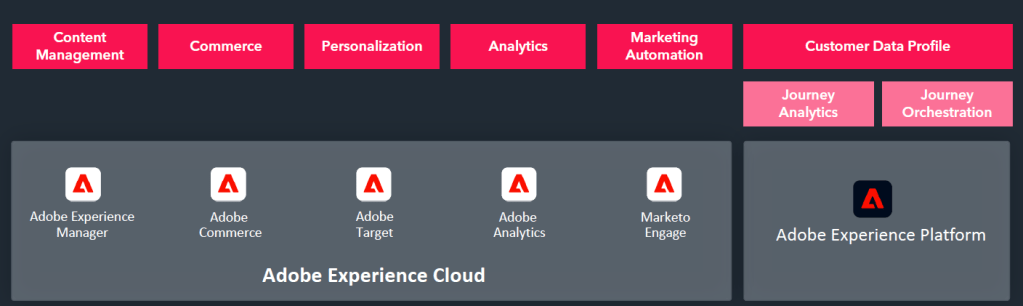
    The best example is Adobe, that offers all kind of other Solutions into the Adobe Experience Platform.

    Screenshot from Adobe Pitch Presentation

    I have never used Adobe in particular, but I did see what is capable of in one company and I was really impressed. They managed a huge integration of different e-commerce and websites, all controlled centrally and accessing the same digital assets. It would be interesting to learn if they also integrated Marketing Engagement and how that worked, especially considering the limitations or absence of GDPR prerogatives in many American Software companies.

    My experience in general is that such huge mega platforms are in theory great and surely on the long run very efficient and robust. But it takes much longer to implement everything until it works, align all the data-set, create the right structure and retrieve all the necessary data that it might discourage and / or limit the Realisation after all. Not to mention the time and commitment to train all the people working with it.

    Conclusion

    if you are not a super digital expert and you don’t want to invest huge amount of time to implement and learn how to manage a complex CMS, go for the Open Source. Also if you are not sure about the partner and you might want to keep the options open and being able to change along the way.

    If you are ready to embrace the challenge and really take the most of an integrated platforms and also you have the company back you up, then go for the close-source. Also for a security point of view, if companies treat very sensible and high risk data / products, that would be also advisable.

  • A Prime Example of the Worst Attempt at Customer prospecting: Spammy, Generic, and Vague – And that from a Digital Agency!


    Today, I received an unsolicited email from a company claiming to specialize in “Digital Experience” solutions. And that would be enough to discredit the company right there. But they went further: their approach embody everything that could go wrong in acquiring new contacts 🙄

    📌 Firstly, they engaged in spamming practices: under GDPR standards, reaching out to individuals without their explicit opt-in is not permissible. While this unfortunate trend is becoming more common, it certainly doesn’t make it ethically or legally sound. 🚫

    📌 To add to the absurdity, this company failed to recognize that we were once their customers! Despite their expertise in “Managed Services for CRM Operations” and “Marketing Automation,” they neglected the basic automation process needed to identify and target existing customers 🤖

    📌 The lack of effort was further evident as they didn’t even bother to send a conventional text-based email. Instead, they opted for an image! Seriously? A cardinal sin in email etiquette in prospecting: you don’t place images as it often triggers spam filters. Fortunately, our system recognized them as a “known company” and didn’t filter them. Fact that they seem to have overlooked. 📧

    📌 Text in German, image in English??? Consistency is the first rule in user experience. I know it’s not always possible with the huge amount of educational materials that a company is expected to provide. But for a single first touch-point Email the minimum you can do is to write in one language. Better would have been to check what is the language I use in LinkedIn (that they cite in the text, taking my job tilte as “automatic dynamic field”) and using dynamic content functions match it with the right text. Basic best practice, I shouldn’t even have to mention this 😔 .

    📌 Their offered services were so extensive and varied that it raised skepticism about their credibility. Claiming proficiency in

    – website design
    – brand strategy
    – CRM management
    – marketing cloud
    – SEO
    – social listening
    – influencer marketing

    all under one roof seemed too good to be true. Any seasoned professional in the digital realm knows the impossibility of excelling in such a wide array of domains. Additionally, if they were truly exceptional in any one area, why not target their communication to me accordingly? 🤔

    In essence, this company’s attempt at digital outreach was a textbook example of how not to approach potential clients and left me questioning both their competence and sincerity in delivering quality services. 👎

    A piece of advice to agencies / digital partner: invest money and efforts to better target your potential customers and show with your work how good you are. Don’t spam, don’t be generic like this, this is a waste of money for you and frustrate your audience.

  • From Chaos to Cohesion

    The Transformative Power of Brand Guidelines

    Content for digital is normally easier and quicker. Very soon marketing departments are able to produce hundreds of social media posts, new blog pieces, mailings and several landing pages with a speed that is not even closed to the one you might had using only printed materials. This is why keeping graphics and images under control in the digital world, especially within an international environment is extremely difficult.

    This is why developing a consistent and strong brand identity is crucial in the dynamic digital landscape. It all begins with a solid idea for your marketing or communication activities, whether it’s a visual, a slogan, or content for various digital channels. However, the excitement of creativity should be tempered with the need for a cohesive Corporate Identity (CI) from the outset.

    We all know how it is in the Marketing departments. Im House we can not accomplish everything, or it is rarely that I have seen a marketing dep. being able to really manage all aspect of marketing and communication without any external support. Normally marketing rely highly on marketing agencies / freelance to help in the creation and production of content. This is why there are so many of them.

    We know how it is, marketing agencies like to be creative. Actually the more they are creative, the more they can charge you. This is why, if you don’t provide a guideline, they will exploit their creativity and come up with the greatest most creative design for each artwork that you request, which will be probably every time very different, depending on the internationalization of the company also country-specific and most important highly expensive.

    Every time agencies will charge you for what it’s called the “conceptual” work, which is basically to think about how to set-up the different design formats and what kind of graphic elements are best. And that is much longer and timely intenst than just work on a “finished format” where they should only include a new logo or text or do small adjustments to fit into the template. Agencies can literally thrive on creativity and without guidelines, they can get carried away, resulting in stunning yet costly creations.

    This is why providing a clear format to agencies for content inclusion, instead of paying for conceptual work, proves not only to be cost-effective but also much more efficient.

    Advantages of a Corporate Identity

    The advantages of a well-defined CI are numerous and I summarize a couple here (you can find more more if you are interested, again I want to express only what it’s outcome from my own experience).

    1. It streamlines communication and collaboration by providing a reference point for everyone involved, improving efficiency and reducing errors. Especially among large marketing team that works across countries or continent, dispersion is very easy. No one wants and can control what happen in the other part of the world meanwhile the company value proposition, through its main message and image, should be communicated and visually expressed consistently and harmoniously among all channels and platforms.
    2. I mentioned how consistency across all digital touchpoints is fundamental, even for smaller companies, ensuring that customers can easily identify and trust your brand. Consistent branding not only builds trust but also fosters customer loyalty. The recognizable color, style, and overall image create a reassuring effect for customers. This trust translates into repeat business, which can be measured through customer satisfaction surveys and retention metrics. It makes the difference when you walk in a busy trade-show full of colors, logos, messages and all kinds of inputs to stand out and be recognized from your customers.
    3. Ignoring the importance of brand guidelines increases the risk of diluting or misusing your brand. Properly implemented guidelines act as a shield, preventing unauthorized alterations and inconsistent representations. Monitoring brand mentions, sentiment analysis, and perception surveys help gauge the effectiveness of brand protection efforts. Especially in the digital endeavors it is so easy to missuses company logos and branding elements. The more the brand is strong and recognized, the more difficult it is to “steal” it for wrong use.
  • Rethinking the Direct Connection to C-Level in Marketing FOR SUCCESSFULL DIGITAL TRANSFORMATION: A Holistic Approach for Success


    I already talked about how the marketing activities and in general companies and their internal Departments are changing during this transformational time. Marketing plays a crucial role in this transformation, leveraging digital channels and technologies to reach and engage target audiences.

    By embracing digital transformation, marketing professionals can

    • enhance customer experiences
    • drive business growth
    • create new opportunities

    This requires a deep understanding of digital trends, adopting agile methodologies, and leveraging data analytics to optimize marketing strategies.

    This is why now it is more necessary than ever before to put Marketing (and all that is around it) at the C-level of an organisation. The importance of how your brand and company is perceived in the digital world is as high as the quality of your products. It is not a “nice-thing to have” rather a must of any organisation to build credibility and trust around them in the digital landscape.

    In this blog post, we will explore why a holistic approach, encompassing collaboration, data-driven decision making, external partnerships, leveraging internal data, and empowerment, is the key to achieving marketing success.

    Marketing&Communication as Strategic Functions

    While a direct connection to the C-Level has long been considered essential, it’s time to challenge this traditional belief. . Marketing is not just about executing campaigns or managing budgets. It is a strategic function that requires a deep understanding of customer needs, market trends, and competitive landscapes. Marketing professionals are responsible for crafting strategies that drive business growth and create long-term value for the organization.

    Collaboration Across Departments

    Marketing success is not achieved in isolation. It requires collaboration and synergy with other departments such as sales, product development, and customer service. By working closely with these teams, marketing professionals can gain valuable insights and align their strategies with the overall goals and objectives of the company.

    Data-Driven Decision Making

    In today’s digital age, data plays a crucial role in driving marketing success. Marketing professionals need access to accurate and timely data to make informed decisions and optimize their campaigns. This requires collaboration with IT and data analytics teams to ensure the availability and accuracy of data.

    External Partnerships

    Marketing is not limited to internal efforts alone. Building strong partnerships with external stakeholders such as agencies, influencers, and media outlets can significantly enhance marketing outcomes. These partnerships require active engagement and collaboration, not just a connection to the C-Level.

    Leveraging Internal Data

    The targeted utilization and linking of cross-departmental internal company data of all kinds will lead to significant competitive advantages. By leveraging advanced data analytics tools and technologies, companies can gain valuable insights from internal data, enabling informed decision-making and a competitive edge.

    Success Through Empowerment

    Rather than relying solely on a direct connection to the C-Level, marketing professionals should focus on empowering their teams and fostering a culture of innovation and creativity. By providing the necessary resources, training, and support, marketing leaders can drive success from within the department.

    Conclusion

    While a direct connection to the C-Level is important, it is not the sole determinant of marketing success. Marketing professionals must adopt a holistic approach that encompasses collaboration, data-driven decision making, external partnerships, leveraging internal data, and empowerment. By embracing this approach, we can navigate the challenges of the modern business landscape and achieve outstanding results. Let’s shift our perspective and unlock the true potential of marketing success.

  • Soft skills needed in the Digital Journey

    The first thing that comes into our heads around the notion of digitalisation and in general the digital world is not for “listening” or “convincing techniques”. Normally we think about which programming language we should learn, what tools we should master, what platforms we should use, not to mention the whole ai “buzz” now everywhere (no ai=useless nowadays) . Yet the importance of more “personal” skills tends to be overshadowed.

    Not very often I heard about needing other more “personal” skills in relation to the success of a digital journey implementation. But ultimately, people are the primary stakeholders in any digital journey. The success of the implementation revolves around on whether they embrace and adopt the tools and processes developed. Ignoring this crucial aspect can lead to failure, as evidenced by the closure of digital startups, with people cited as the primary reason for their demise.

    Just today I read about the fail of a “digital” start-up where the CEO mentioned “people” as the first reason for its failure. He also mentioned that before having a finished product, he should have started with talking with the people first and understand their real needs. And this is exactly what I also learned in my professional experience. It doesn’t bring anything to have a perfect and ultra performing tool or platform if this is not needed or worse hated from their users.

    In my professional experience, I’ve learned that certain “personal” skills are paramount when transforming old processes into digital ones or creating new ones. Here are the skills that, in my view, are essential:

    Listening, listening and again listening


    Absolutely, I am 100% sure about listening in the first place of this list. Before diving into any initiative, it’s crucial to engage with colleagues, understand their workflows, and inquire about their current practices. For instance, again from my own experience, when we had to transition from paper forms to digital devices for collecting contact information at events (like trade-shows), instead of starting with what tool we can use, which device are compatible,… the initial question should have been: “How do we traditionally welcome customers during a physical event?”

    Asking this question helps uncover essential details such as whether each salesperson needs an individual device, if a touch-screen for attendees is more suitable, or if having a dedicated person to record information centrally is the better option. Just knowing how the Team usually interact with customers during events lead to understand if a direct collecting in our smartphone even could be a possibility, since they might be too busy talking to them or maybe they might prefer a quick scanning at visit cards and later on include eventual further information.

    These insights are only accessed through open discussions and the exchange of information. By actively listening to the team’s input, we can accurately identify the specific requirements that need to be addressed. This collaborative and communicative approach ensures that any digital implementation aligns seamlessly with existing practices and meets the actual needs of the team.

    Be Patient and Repetitive


    Assuming that a single training session or one email is sufficient for a successful digital implementation process is either living in another universe or indicative of no experience in such projects. Achieving comprehensive learning takes repetition – approximately 10 times to solidify one full understanding. It’s not a reflection of lacking skills or laziness; rather, it’s a reality that individuals juggle various tasks and challenges in their professional lives. They might not immediately apply what they’ve learned due to the demands of their roles.

    Expecting users to recall everything from a training or webinar, especially when they try the tool much later, sets the stage for frustration and disrupts the learning experience. It falls on us to be the constant support, reiterating, explaining, and training repeatedly. A positive approach, delivered with a smile and gentle guidance, is key. What may seem obvious to those immersed in the digital realm every day can be challenging for occasional users to remember. Patience and repetition become the pillars of ensuring a smooth and effective learning experience.

    Flexibility is your best friend

    Sometimes what I had in mind was very far from reality. For example I once created a perfect funnel that started from and adv in social media, followed by a series of email and ending with a 1:1 meeting with an expert.

    However, reality struck hard – the social media ads weren’t reaching the right audience, the landing page went largely unnoticed, and the expected clicks simply weren’t materializing. The entire funnel came to an unexpected halt. Internally, the follow-up process faced hurdles due to a lack of information among the experts.

    In hindsight, a major misstep was expecting our target audience to react precisely as we envisioned, not accounting for their actual behavior. I fully own up to this oversight; as digital experts, it’s our responsibility to ensure actions align with real habits rather than being overly theoretical. The key lesson here is to stay prepared for quick and frequent adaptations. Flexibility is crucial in the digital realm, where changes in strategy may be necessary to align with the audience’s actual responses rather than our anticipated reactions.

    Positive and Enthusiast no matter what


    We’re bound to face numerous challenges along the way, with significant pushback and criticism from various stakeholders. This is not surprising, considering human nature tends to resist change and new things. The fear stems from a potential loss of control over tasks and a reevaluation of one’s role in the process. People might feel redundant, especially if their responsibilities shift due to the implementation of new tools. Skepticism is also expected, as past experiences with various digital tools, some successful and others not, might breed doubt.

    In navigating these pitfalls, our role as “digital drivers” becomes pivotal. We must show and keep unwavering confidence, positivity and assurance that the changes we’re proposing are not only right but necessary. Reassuring our team that the new ways of working are well-founded and beneficial becomes a crucial aspect of steering through the uncertainties.

    Master convincing Technics

    The last critical skill for today, which I believe is indispensable, revolves around what I previously referred to as “convincing techniques” or the principles of influence. These serve as highly effective strategies for persuading and gaining the cooperation of others. This becomes particularly crucial when introducing new tools or altering processes that may initially demand more effort, risking resistance if not convincingly presented. Even if such changes are mandated from the top, success hinges on ensuring that the users are not just informed but actively brought on board. Mere decisions won’t suffice; it requires a hands-on approach, ensuring everyone feels heard and valued.

    Several influencing techniques prove valuable in this endeavor:

    1. Appeal to Emotions:

    • Engaging individuals passionate about technology, positioning the change as a revolutionary leap forward. It’s vital to be cautious, as excitement may wane if the novelty factor diminishes over time.

    2. Logical Reasoning (“Added Value”):

    • Clearly articulating the benefits the new process or features bring—whether increased efficiency, boosted sales, or other improvements. It’s crucial to consistently highlight the ultimate goals and the positive outcomes.

    3. Social Proof and Fear of Missing Out:

    • Staying informed about industry trends, learning from others, and sharing those insights within the organization. Creating a sense of urgency by looking beyond our immediate context and observing competitors. A robust network is essential for obtaining such information, as it often relies on word of mouth or connections.

    In essence, successful implementation goes beyond decisions; it requires creating a narrative that resonates emotionally, demonstrating the tangible value through logic, and staying informed through a strong network. This approach ensures not only acceptance but active participation in the envisioned change.

    Disclaimer: Images are generated through ai by the tool Canva